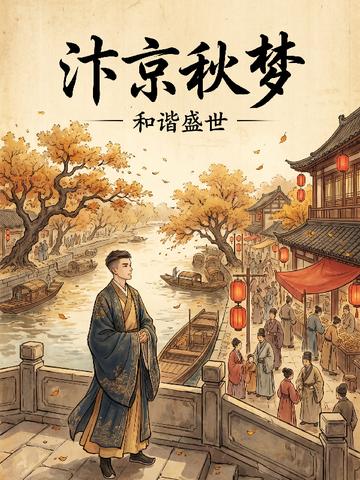
In the autumn of the third year of Xining, the Bianhe River burst its banks and displaced people everywhere.
Zhao Yan woke up from the mud, with nothing on his body except a black letter on his chest that was slightly hot. Twenty-four words are engraved on it - prosperity, democracy, civilization, harmony, freedom, equality, justice, rule of law, patriotism, dedication, integrity, and friendliness. No one in this era can understand these words.
He was taken in by a dilapidated county town. The county magistrate Li Zhizhong has been an official for fifteen years, but he only learned to bow his head; the blacksmith Liu Dacheng has been hammering for thirty years, but he has only learned to accept his fate; the old farmer Zhou Dashuan has been farming all his life, but he has only learned to borrow debts, repay debts, and borrow again.
Zhao Yan had no official position, no fame, and no money. He only has one tablet and twenty-four words that are destined to burn through the old order.
An iron plow turns barren fields into fertile soil. A piece of faith money allows the poor to straighten their backs. A trustworthy deed makes credit more precious than gold.
This is a story about a book that goes from cold to hot. This is the story of a group of people who went from kneeling to standing up. This is the story of an idealist making his way through the mud.
When the autumn leaves of the Bianhe River have fallen off, the roots of the New Song Dynasty have already penetrated into the soil.