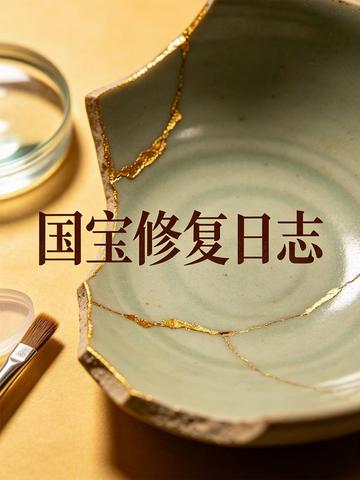
Before Lin Wantang's death, her grandfather left her an old blank diary and said: "When you complete one hundred national treasures, you will know who I am."
She thought it was a last word until she repaired a piece of porcelain for the first time - a line of words appeared out of thin air in her diary:
"A blue and white underglaze red mountain water vase from the Kangxi period of the Qing Dynasty was stolen from the East Road outside the Forbidden City in 1924 and is now hidden in someone's private residence in Osaka."
That day she realized that what her grandfather left her was not a diary, but a system.
Cheng Muzhi is the most famous "foreign comprador" in Tianjin, specializing in purchasing Chinese antiques for foreigners.
Lin Wantang first met him at a cultural relics auction - he spent generously to buy a stolen gilded Buddha statue, and she thought he was a traitor.
The second time I met him was in the darkroom of the cultural relics restoration factory - he quietly sent the Buddha statue back and said, "To repair it, I need the people behind it."
She relied on the system to find out the whereabouts of the cultural relics, and he relied on his identity to "buy" the cultural relics back.
Cultural relics were recovered one by one, but the system's tasks became more and more difficult.
From "restoring a piece of porcelain" to "finding a national treasure that is about to be shipped out of the country within a week",
Lin Wantang began to suspect that what the system gave her was not a task, but an early warning.
"Every cultural relic I restore was brought back from a dead end."
In 1938, Cheng Muzhi's identity was exposed and he was wanted by the Japanese army.
Lin Wantang's system suddenly popped up with the last mission: "The ultimate mission: protect the 'List of Cultural Relics Moved to the South of the Forbidden City' from being intercepted. Mission reward: The truth about my grandfather's identity."
The price may be his life. The executor of the task is Cheng Muzhi.