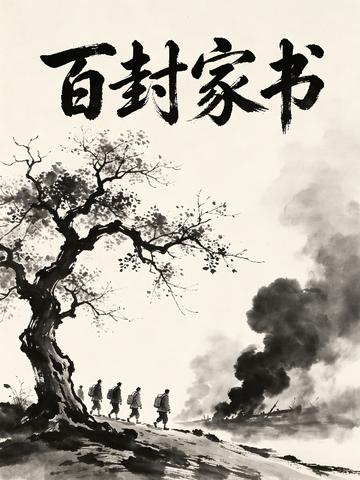
In the winter of the first year of Baoyuan, one hundred and two men in Qingxi Village in the south of the Yangtze River were dragged away from the hot bed by the same Li Zheng. The third grade will draw one, the fifth grade will draw two. Those who do not go will be considered guilty of desertion. They were tied with ropes and walked three thousand miles to the Hengshan Mountains in the northwest. They were scattered and organized into the Song-Xia defense line that stretched for 1,200 miles.
After six years, no one came back alive.
The history books only read: "Song and Xia fought at war, and more than 100,000 people died, and they were given 255,000 silver silk every year." No one remembers their names, and no one knows where their bones are buried. It wasn't until the sixth year of Jingyou's reign that a failed scholar retrieved a hundred letters that had never been sent from abandoned beacon towers, under the stones of mass graves, and in the pockets of dead soldiers.
Seventy-two are letters home from soldiers to their parents, wives and children, and twenty-eight are letters sent from home to the border. There is no strategizing in the letter, no support for the family and the country. There are only black buns with teeth, inflamed tattoos, drafty barracks in winter, and the sentence "I want to go home" repeated a thousand times.
People on the front line are looking for food among the dead, while people in the rear are digging Guanyin soil under exorbitant taxes and miscellaneous taxes. They reported good news to each other but not bad news, and used lies to support each other's survival. War is never just about fighting on the battlefield. It is a noose with both ends tightening the necks of ordinary people.
The scholar compiled these one hundred letters into a collection without signatures or titles. Finally, he buried the book under the deserted old locust tree in Qingxi Village.
The wind blew through the flowers, as if nothing had happened.
Only these torn pages prove that a hundred ordinary people