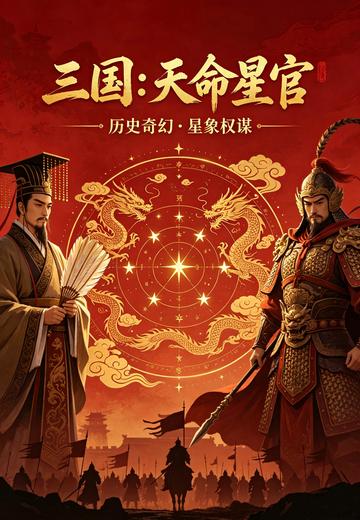
In 184 AD, a meteorite crashed into Yingchuan, bringing the consciousness of Su Chen, a doctor of modern astrophysics, into the Eastern Han Dynasty and possessing a low-level official. He has no system or golden fingers, only fragmented astronomical knowledge and vague historical memories in his mind.
Su Chen firmly believed that "God's actions are consistent" and opposed the superstition of prophecies. He saved the people by predicting lunar eclipses, and was recommended by Huangfu Song to the Luoyang Taishi Bureau, where he made armillary spheres and calibrated solar eclipses. He became famous, but he offended the powerful by refusing to fabricate auspicious signs and was demoted from the capital.
In troubled times, he defected to Cao Cao, Yuan Shao, and Liu Biao successively, but found that the overlords of all parties only regarded him as an astrologer. It was not until he assisted Zang Hong in Qingzhou that he built the first observatory to train astronomy students. After Zang Hong's defeat, he fled to Cao Cao's command. During the Battle of Guandu, he helped Cao Cao burn Wuchao with accurate weather forecasts. After the war, he proposed to establish the "Gewu Yuan" to promote mathematics education, but was boycotted by Xun Yu and others because it violated the interests of the Confucian gentry.
Su Chen realized that he could not realize his ideals in Cao Ying, so he went south to join Liu Bei. In the Battle of Chibi, he provided wind direction prediction to help the fire attack win. After entering Shu, Liu Bei supported him in establishing the first Gakushu Academy in Chinese history to promote the decimal system and scientific knowledge. He and Zhuge Liang were both friends and enemies - Liang talked about yin and yang and the five elements, and he talked about the laws of physics.
During the Northern Expedition, Su Chen was responsible for meteorological support and terrain surveying. In Wuzhangyuan, he observed a supernova explosion and had a premonition that his life would be over. Before his death, he handed Zhuge Liang his lifelong work "Treatise on Astronomy". There was no prophecy in the book, but only mathematical formulas and observational data. Zhuge Liang sighed with tears in his eyes: "You are the one who truly knows heaven."
Reader comments
In 184 AD, a meteorite crashed into Yingchuan, bringing the consciousness of Su Chen, a doctor of modern astrophysics, into the Eastern Han Dynasty and possessing a low-level official. He has no system or golden fingers, only fragmented astronomical knowledge and vague historical memories in his mind.
Su Chen firmly believed that "God's actions are consistent" and opposed the superstition of prophecies. He saved the people by predicting lunar eclipses, and was recommended by Huangfu Song to the Luoyang Taishi Bureau, where he made armillary spheres and calibrated solar eclipses. He became famous, but he offended the powerful by refusing to fabricate auspicious signs and was demoted from the capital.
In troubled times, he defected to Cao Cao, Yuan Shao, and Liu Biao successively, but found that the overlords of all parties only regarded him as an astrologer. It was not until he assisted Zang Hong in Qingzhou that he built the first observatory to train astronomy students. After Zang Hong's defeat, he fled to Cao Cao's command. During the Battle of Guandu, he helped Cao Cao burn Wuchao with accurate weather forecasts. After the war, he proposed to establish the "Gewu Yuan" to promote mathematics education, but was boycotted by Xun Yu and others because it violated the interests of the Confucian gentry.
Su Chen realized that he could not realize his ideals in Cao Ying, so he went south to join Liu Bei. In the Battle of Chibi, he provided wind direction prediction to help the fire attack win. After entering Shu, Liu Bei supported him in establishing the first Gakushu Academy in Chinese history to promote the decimal system and scientific knowledge. He and Zhuge Liang were both friends and enemies - Liang talked about yin and yang and the five elements, and he talked about the laws of physics.
During the Northern Expedition, Su Chen was responsible for meteorological support and terrain surveying. In Wuzhangyuan, he observed a supernova explosion and had a premonition that his life would be over. Before his death, he handed Zhuge Liang his lifelong work "Treatise on Astronomy". There was no prophecy in the book, but only mathematical formulas and observational data. Zhuge Liang sighed with tears in his eyes: "You are the one who truly knows heaven."

In 184 AD, a meteorite crashed into Yingchuan, bringing the consciousness of Su Chen, a doctor of modern astrophysics, into the Eastern Han Dynasty and possessing a low-level official. He has no system or golden fingers, only fragmented astronomical knowledge and vague historical memories in his mind. Su Chen firmly believed that "God's actions are consistent" and opposed the superstition of prophecies. He saved the people by predicting lunar eclipses, and was recommended by Huangfu Song to the Luoyang Taishi Bureau, where he made armillary spheres and calibrated solar eclipses. He became famous, but he offended the powerful by refusing to fabricate auspicious signs and was demoted from the capital. In troubled times, he defected to Cao Cao, Yuan Shao, and Liu Biao successively, but found that the overlords of all parties only regarded him as an astrologer. It was not until he assisted Zang Hong in Qingzhou that he built the first observatory to train astronomy students. After Zang Hong's defeat, he fled to Cao Cao's command. During the Battle of Guandu, he helped Cao Cao burn Wuchao with accurate weather forecasts. After the war, he proposed to establish the "Gewu Yuan" to promote mathematics education, but was boycotted by Xun Yu and others because it violated the interests of the Confucian gentry. Su Chen realized that he could not realize his ideals in Cao Ying, so he went south to join Liu Bei. In the Battle of Chibi, he provided wind direction prediction to help the fire attack win. After entering Shu, Liu Bei supported him in establishing the first Gakushu Academy in Chinese history to promote the decimal system and scientific knowledge. He and Zhuge Liang were both friends and enemies - Liang talked about yin and yang and the five elements, and he talked about the laws of physics. During the Northern Expedition, Su Chen was responsible for meteorological support and terrain surveying. In Wuzhangyuan, he observed a supernova explosion and had a premonition that his life would be over. Before his death, he handed Zhuge Liang his lifelong work "Treatise on Astronomy". There was no prophecy in the book, but only mathematical formulas and observational data. Zhuge Liang sighed with tears in his eyes: "You are the one who truly knows heaven."