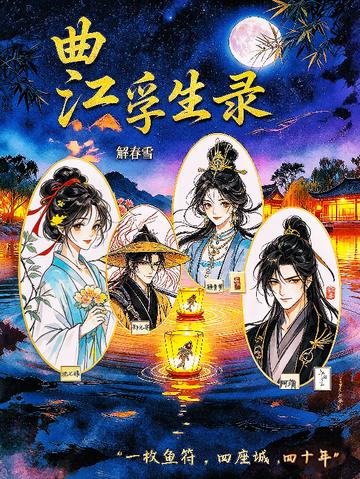
(The cover is generated by AI and will be changed later)
In the twenty-fifth year of Kaiyuan, Shen Qiniang, a fish seller by the Qujiang Pond, received a gold-plated silver fish charm from a down-and-out scholar because of the charity of half a fish.
That's Li Bai.
A fish charm, a forty-year agreement. From Qujiang in Chang'an to Nanshi in Luoyang, from Yangzhou Canal to Jinjiang in Chengdu, Shen Qiniang used a golden tongue to taste the delicacies of the prosperous times and the rough delicacies of the troubled times, and guarded the secret fish soup recipe passed down from her father all her life.
She said: "Craftsmanship is for people, not for money."
In troubled times, she gave recipes to her peers, took in homeless orphans, and left a light for separated old friends in a dock restaurant.
What happened to those people?
Zheng Yuan'an, a businessman from Luoyang, remembered that "being a person is more important than doing business" because of a recipe book; Gu Qingluo, a musician from Yangzhou, remembered Chang'an that cannot be returned to everyone with his ears; A Pu, a potter from Chengdu, made a bowl with both hands, with a small fish engraved on the bottom of the bowl - that was the only mark left to him by his master.
Four people, four cities, forty years. In the prosperous times, they were separated in troubled times, and finally reunited by the Jinjiang River.
That night in Shangyuan, the river was full of lights. The white-haired Qiniang put the fish charm into the river lantern and watched it flow down the river.
"Li Lang, you don't have to pay back the fish money."
She kept the Shen family's secret recipe, and she also kept something more important than the secret recipe.
With a pot of fish soup and a pair of chopsticks, I walked through the entire prosperous Tang Dynasty.