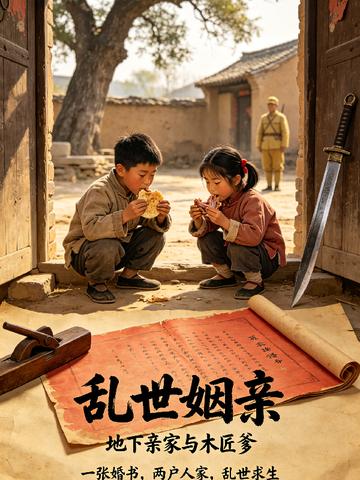
In the twenty-sixth year of the Republic of China, the Japanese army trampled through the villages of North China. Carpenter Chen Shouyi slapped a marriage certificate on the table of farmer Lin Wenbin - he wanted to cling to the Japanese army, he wanted cover from the underground party, and the two fathers had their own agendas, tying the children's lives into a lifeline in troubled times.
Eight years after the fall, the marriage certificate became a talisman and a knife that cut into the bones. Chen Shouyi built artillery towers, requisitioned grain, and betrayed his fellow villagers, turning from a carpenter into the vice-president of the Maintenance Association; Lin Wenbin roamed the cutting edge as a "traitor's relative" and sent forty-seven pieces of information. His left hand was disabled but his back was straight. After the victory of the Anti-Japanese War, liquidation came. Chen Shouyi reported on his relatives to protect himself, and Lin Wenbin was imprisoned and disabled. The marriage contract between his son Chen Shugen and Lin Xiulan was also broken in half under the scissors.
More than twenty years of entanglement, from marriage letters to red flags, from betrayal to forgiveness. When Chen Shouyi became a prisoner, when Lin Wenbin left a crack at the door of the courtyard, and when Chen Shugen finally walked into the Lin family for dinner openly and openly - the two "in-laws" understood: the rope may be broken, but the root is still there; grudges can be resolved only because the person is still alive.
This is an anti-war novel written in the dirt. There are wood shavings and bayonets, bacon and bran cakes, black coats in the reeds, and new seedlings under the old locust trees. It writes about how little people learn to stand in the blood and fire, learn to forgive, and learn to be a family again after breaking the rope.