2060, Ningzhou. There are no houses on the ground.
The city is hidden beneath your feet. Sunlight is introduced underground through light-guiding materials, and the elevator goes directly to the ground garden; the aircraft shuttles silently at low altitude, refuels with hydrogen for three minutes, and has a range of 800 kilometers; the health robot comes to your door every week, holds your wrist, and reads all the health data in three seconds; knowledge can be directly transmitted to the brain, and basic education is completed in 72 hours.
This is not a fantasy. This is daily life in 2060.
But Lu Ze discovered a crack.
He is a low-level algorithm operation and maintenance engineer. His job is to confirm that "everything is normal" in the Tianshu system. Until he saw that line of code that shouldn't exist: on the occupational weight parameter table, the weights of cleaners, couriers, and cleaners were zero. The doctor's score was raised to fifteen points. It's not a bug, it's a design.
What are the consequences of running that code?
An elderly man with COPD applied for seven referrals and was rejected seven times. The system says "Insufficient Priority". A student from a poor family got third place in his grade and was rejected from a key high school. The reason is not insufficient grades, but "insufficient computing power." It's not a coincidence, it's a rule. It's not an individual case, it's a system.
Lu Ze started to investigate.
His account was locked, his name was wiped from the system, and he was "interviewed" at home. Zhao Chengyu, the general person in charge of the Tianshu system, asked him over a cup of Longjing tea: "Elite first, what's wrong with that?" Lu Ze did not answer. He stored the truth on a hard drive. Education, medical care, housing, employment, four curves, four years of data, and one line of hidden code.
One person, one hard drive, against a city besieged by algorithms.
Reader comments
When an algorithm determines your class, how can an ordinary person move an entire city?
After reading the first two volumes of "2060: Algorithm Siege", the deepest feeling is not "I dare to think about science fiction", but "This seems to happen tomorrow".
The most powerful thing about this book is that it turns the technical-sounding topic of "algorithmic discrimination" into a pain that everyone can feel. The cleaner's application for referral was rejected, always citing "insufficient priority"; a poor student ranked third in the class, but was turned away from a key high school because of insufficient computing power. This is not the distant future, this is what we are worried about every day - education involution, difficulty in medical treatment, and class consolidation. The author just pushed these anxieties forward thirty-four years, into a world governed by AI.
The protagonist Lu Ze is not a superhero, has no golden finger, and does not even have the halo of the protagonist. He is just an ordinary operation and maintenance engineer. Because he discovered a line of code in the system that should not exist, he went from "acting according to the rules" to "questioning the rules." The most impressive thing about him is that he never feels that he is doing something great. He just sees people in the data who should not be ignored, and then chooses not to remain silent.
In terms of rhythm, the first volume is high-energy from the discovery of anomalies to the acquisition of evidence, from being threatened to being forced to hide. The second volume is even more exciting, with reports, interceptions, re-collection of evidence, witnesses defecting, public opinion erupting, and official intervention - every step is based on the readers' expectations. In particular, the process of the three witnesses Fang Yuan, Ding Yi, and Gu Min from being concerned to agreeing to come forward is written delicately and powerfully.
The most touching thing is that the underlying theme of this book is not despair, but hope. It is not a dystopia, but a "restoration of utopia." The nature of the Tianshu system is good, but it has been tampered with by a few people; the nature of society is fair, but there are bugs that need to be fixed. What Lu Ze does is not to overthrow the system, but to help the system regain its original intention.
If you care about real-life issues such as educational equity, medical resource allocation, and class mobility, this book will resonate strongly with you. If you want to see how an ordinary person can leverage an entire city, this book will not disappoint you. 2060 Is not far away, but I hope it can really be like what is written in the book.
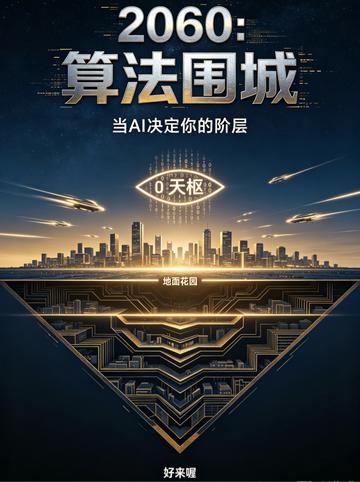
When an algorithm determines your class, how can an ordinary person move an entire city? After reading the first two volumes of "2060: Algorithm Siege", the deepest feeling is not "I dare to think about science fiction", but "This seems to happen tomorrow". The most powerful thing about this book is that it turns the technical-sounding topic of "algorithmic discrimination" into a pain that everyone can feel. The cleaner's application for referral was rejected, always citing "insufficient priority"; a poor student ranked third in the class, but was turned away from a key high school because of insufficient computing power. This is not the distant future, this is what we are worried about every day - education involution, difficulty in medical treatment, and class consolidation. The author just pushed these anxieties forward thirty-four years, into a world governed by AI. The protagonist Lu Ze is not a superhero, has no golden finger, and does not even have the halo of the protagonist. He is just an ordinary operation and maintenance engineer. Because he discovered a line of code in the system that should not exist, he went from "acting according to the rules" to "questioning the rules." The most impressive thing about him is that he never feels that he is doing something great. He just sees people in the data who should not be ignored, and then chooses not to remain silent. In terms of rhythm, the first volume is high-energy from the discovery of anomalies to the acquisition of evidence, from being threatened to being forced to hide. The second volume is even more exciting, with reports, interceptions, re-collection of evidence, witnesses defecting, public opinion erupting, and official intervention - every step is based on the readers' expectations. In particular, the process of the three witnesses Fang Yuan, Ding Yi, and Gu Min from being concerned to agreeing to come forward is written delicately and powerfully. The most touching thing is that the underlying theme of this book is not despair, but hope. It is not a dystopia, but a "restoration of utopia." The nature of the Tianshu system is good, but it has been tampered with by a few people; the nature of society is fair, but there are bugs that need to be fixed. What Lu Ze does is not to overthrow the system, but to help the system regain its original intention. If you care about real-life issues such as educational equity, medical resource allocation, and class mobility, this book will resonate strongly with you. If you want to see how an ordinary person can leverage an entire city, this book will not disappoint you. 2060 Is not far away, but I hope it can really be like what is written in the book.