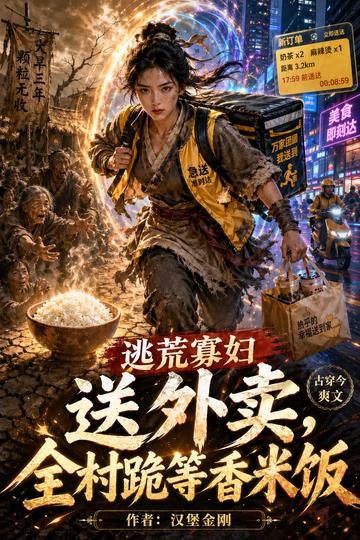
After three years of severe drought, the people of Qingshi Valley have even stripped the trees of their bark to eat.
Widow Liu Xingniang goes up the mountain to look for edible roots, but falls through a glowing iron door. When she opens her eyes, iron wagons are racing through the streets and skyscrapers reach into the clouds. A young delivery rider in a yellow vest shoves an insulated delivery bag into her arms. “Auntie, we’re short on couriers. The pay’s per order, and meals are provided!”
Liu Xingniang can’t read, can’t ride an electric scooter, and has no idea why phones yell at people.
But she can find her way, carry people, guard her food, and chase a wild boar for three miles along a mountain path.
Modern people laugh at how backward she is, but she hauls two boxes of milk tea up twenty-eight flights of stairs and delivers them right on time.
The delivery platform gives her five stars, and a steaming bowl of white rice appears in the broken pottery bowl back in ancient times.
From then on, Liu Xingniang delivers takeout in the modern world by day and runs a soup kitchen in ancient times by night. Anyone who tries to steal her grain gets an earful through her modern loudspeaker until the whole village’s ears are ringing; anyone who tries to sell a child for food gets a faceful of rice, flour, oil, and salt, courtesy of Liu Xingniang.
Before long, the whole city knows there’s an “Iron-Legged Auntie” who takes on the toughest deliveries.
Meanwhile, people in Qingshi Valley begin whispering that Widow Liu has a yellow-robed Food God backing her.
Only Liu Xingniang knows that the Food God nags her through her phone every day: “You have an order that is about to be late.”

The writing is quite good, but how do Shen Yan and the others know about another world and system?