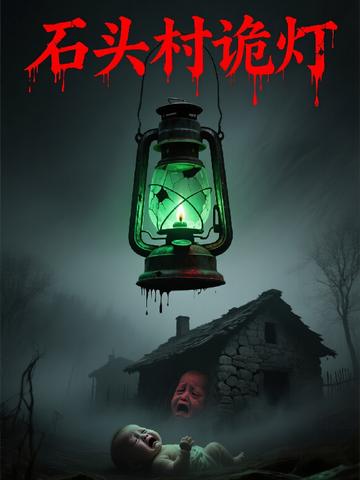
"You can't go to Stone Village. There are babies crying there at night, and there are inexplicable lights... Evil!" The nearby villagers were very secretive about this deserted village, waving their hands repeatedly, and no one dared to mention its name.
A few young people who did not believe in evil wanted to find out what was going on. Under the reluctant guidance of the villagers, they entered this forgotten village. However, there are only ruins, empty houses and abandoned wells in front of us, and the whole village is so silent that even the sound of the wind is like a whimper.
As night fell, strange cries sounded quietly - like a baby crying or a woman wailing, sometimes distant and sometimes close, carrying a chill that penetrated into the bone marrow. What's even more creepy is that there are flickering lights in the darkness, wandering like will-o'-the-wisps, as if someone is walking through the ruins with a lantern...
After one night, the explorers went crazy and died. The survivors barely escaped with the help of the rescue team, but they suffered a mental breakdown and were incoherent. As the investigation deepens, the secrets of Stone Village gradually reveal deeper horrors.
Reader comments
The story is exemplary in handling suspense: the narration of the short-haired man only reveals part of the truth, and key information such as "the reason why the villagers disappeared" and "the specific status of the crazy person" are deliberately left blank. This kind of restraint not only prevents the overflow of horror, but also stimulates readers' imagination, which is similar to the creative technique of "unit story oppression" in "The House". At the end, Zhou Haibing's sentence "Let's go tomorrow" comes to an abrupt end, which not only strengthens the ritual sense of decision-making, but also pushes the suspense to a climax, making readers have strong expectations for the subsequent development.
The story opens with a pyrotechnic scene of a late-night snack stall. Through details such as the aroma of barbecue, the shadow of sycamore trees, and the halo of car lights, a real and palpable summer night atmosphere is constructed. However, the author cleverly uses the conversation at the next table as a turning point to gradually lead the daily relaxed atmosphere to the weird. The short-haired man's description of the "Stone Village" is not a straightforward narrative, but is layered with images such as "babies crying", "erratic lights" and "villagers disappearing collectively", and every turn is based on the audience's reaction (such as Dong Yuxin's fear, Rong Ruoqiong's excitement) to heighten the suspense, making the sense of terror spread like ripples. This style of writing, from reality to fiction, not only retains the basis of reality, but also foreshadows the supernatural elements. It is reminiscent of the interweaving of rules, ghost stories and infinite reincarnation in "The End of Ten Days", which highlights the technical tension of suspense narrative.


The story is exemplary in handling suspense: the narration of the short-haired man only reveals part of the truth, and key information such as "the reason why the villagers disappeared" and "the specific status of the crazy person" are deliberately left blank. This kind of restraint not only prevents the overflow of horror, but also stimulates readers' imagination, which is similar to the creative technique of "unit story oppression" in "The House". At the end, Zhou Haibing's sentence "Let's go tomorrow" comes to an abrupt end, which not only strengthens the ritual sense of decision-making, but also pushes the suspense to a climax, making readers have strong expectations for the subsequent development. The story opens with a pyrotechnic scene of a late-night snack stall. Through details such as the aroma of barbecue, the shadow of sycamore trees, and the halo of car lights, a real and palpable summer night atmosphere is constructed. However, the author cleverly uses the conversation at the next table as a turning point to gradually lead the daily relaxed atmosphere to the weird. The short-haired man's description of the "Stone Village" is not a straightforward narrative, but is layered with images such as "babies crying", "erratic lights" and "villagers disappearing collectively", and every turn is based on the audience's reaction (such as Dong Yuxin's fear, Rong Ruoqiong's excitement) to heighten the suspense, making the sense of terror spread like ripples. This style of writing, from reality to fiction, not only retains the basis of reality, but also foreshadows the supernatural elements. It is reminiscent of the interweaving of rules, ghost stories and infinite reincarnation in "The End of Ten Days", which highlights the technical tension of suspense narrative.