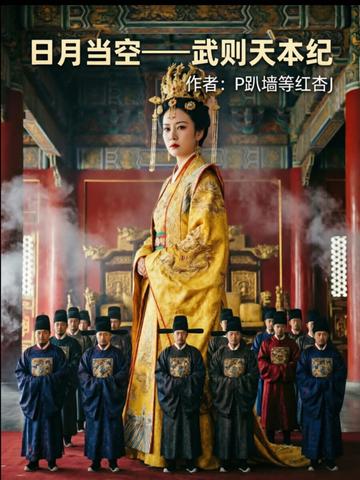
Introduction to "The Sun and the Moon in the Sky: The Chronicles of Wu Zetian"
In the eleventh year of Zhenguan, fourteen-year-old Wu Mei entered the Tang court. She didn't know that she would spend her life walking a road that no one had ever walked before - from being a talented person of Taizong to being the empress of Gaozong, and eventually becoming the only female emperor in Chinese history. This is not just a palace legend. Under the green lights of Ganye Temple, she won back the emperor's heart with the song "Looking at Zhu Chengbi"; behind the curtain of Zichen Palace, she showed her talent for governing the country with "Twelve Proposals". She is a mother, but she kills her daughter with her own hands for the queen; she is a wife, but she controls the world from her husband's bedside. She initiated palace examinations and attacked the powerful families, allowing poor scholars to see the light of day for the first time; she appointed ruthless officials and bloodbathed the clan, and also silenced the court.
"The sun and the moon are in the sky" is a word she coined, and it is also a metaphor for her life - light and shadow coexist. She broke through the thousand-year-old Iron Curtain as a woman, changed Tang Dynasty to Zhou Dynasty, and ascended the throne as emperor amidst the scoldings of "Female Chicken Si Chen". In her later years, under the solitary lamp of Shangyang Palace, she issued an edict to remove her imperial title and was buried with her husband as a queen. Only a wordless monument is left, leaving the merits and demerits of a life to be judged by time. This book reproduces this complex emperor with a writing style that is divided into three parts historical fact and seven parts fiction. It does not deify its greatness, nor avoid its cruelty. Between power and gender, maternal love and ambition, creation and destruction, it explores how individuals struggle, break through and destroy in the torrent of history. When you open this book, you will see not only a woman's epic, but also a civilization's difficult exploration at its limits - about power, about gender, and about how far humanity can go forward on the bronze wall of history. Empress Wu Zetian left behind an eternal mystery