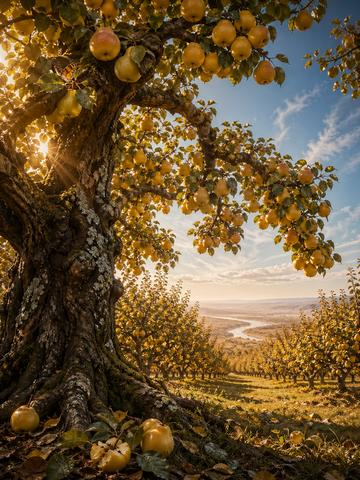
In the fifth year of Xianfeng in the Qing Dynasty (1855), the Yellow River changed its course and Tangyi became a wasteland. Inspired by the old farmer Meng Laoliu, the survivors Lu Qiushi and Shen Ruoshui began to try to plant pear trees in the barren sandy land. After experiencing famine, drought, and oppression by landlords, they cultivated a kind of crisp pear that "melts as soon as it hits the ground" and named it Luosu. After decades of hard work, Luosu has developed from a single wild tree to a famous tribute product, and the pear orchards have become forests.
A hundred years later, the people of Tangyi in the New China era once again dug out hope from the sand. Lu Wangli inherited his ancestral skills and cooperated with Lin Xiaoman, a technician at the Provincial Academy of Agricultural Sciences, Zhao Dehou, deputy county magistrate, and others to rebuild an orchard on the deserted beach. After the twists and turns of the Great Leap Forward, the Cultural Revolution, and reform and opening up, he expanded the area of Luoshu cultivation to the largest in the world. Businessman Chen Xiaodong opened up cold chain transportation and overseas markets, and Fang Shouzheng's great-granddaughter Fang Yaqin compiled "Tangyi Pear Stories" to help brand protection. In 1994, Tangyi was officially named "Lidu".
The whole book takes "melts as soon as it hits the ground" as the core image, telling the epic story of a century-old pear that destroys and breeds new life, and the suffering condenses the sweetness.