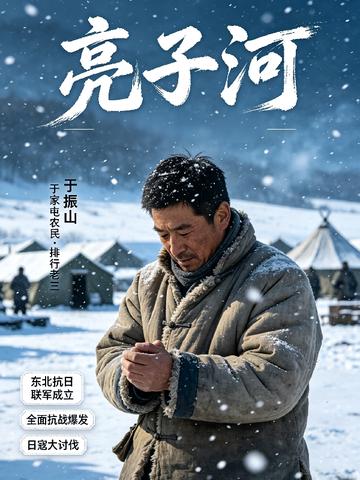
Liangzi River, a little stream so small it isn’t even marked on maps.
In the autumn of 1931, men in yellow uniforms arrived at Yujia Village by the river.
Yu Zhenshan was twenty-five, the third son in his family, and a farmer. He couldn’t read and had never traveled far. His greatest wish in life was simply to have enough to eat, stay warm, and get by.
But life would not let him.
After the Japanese came, his greatest wish became this: to stay alive.
He was no hero. He had never led a battle or devised a strategy. He only wanted to survive in a world turned upside down.
But the times would not let him.
Fourteen years. He went from being a farmer who trembled at the sight of the dead to a man who could hold a gun, endure hunger and cold, and stand firm even when all seemed lost.
He wants you to know that most Chinese people in that war were not born warriors. They were driven to it.
He also wants you to know that there were people on this black soil who left no names behind, but never went down on their knees.
Every inch of our land was soaked in blood. A hundred thousand young men joined the army.
This book is dedicated to those whose names were never recorded.