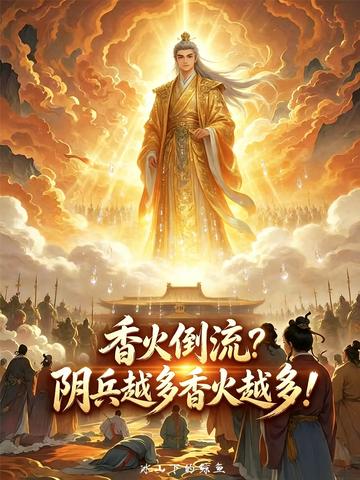
[Deities, farming, conquest, and raising a vast army. Golden finger: incense flows backward, so the more Yin soldiers you have, the more incense you receive!]
Everyone transmigrates to another world and becomes a wild god.
Shen Yun is trapped inside a stone statue with a broken arm from the start, forced to watch as other deities seize the advantage.
Fortunately, he discovers by chance that on the first and fifteenth days of every month, other deities have to pay incense to the subordinate gods and Yin soldiers under their command.
But his subordinate gods and Yin soldiers can actually provide him with incense instead!
The more Yin soldiers and subordinate gods he has, the more incense he gets!
Other deities hesitate for ages before appointing a single Yin soldier or developing a subordinate god, worried they won’t be able to afford the incense costs.
Shen Yun, on the other hand, welcomes everyone, believing more is always better.
[Gray-duty Yin soldier Du Li contributed ten incense points]
[The mountain god of Tupoling contributed one thousand incense points]
[The mountain god of Cangwu Mountain contributed one hundred thousand incense points]
Shen Yun turns around and uses the incense to appoint even more Yin soldiers and subordinate gods.
But in this world, no matter how high their divine rank, any god who has not been appointed is still just a wild god!
While other deities are still fighting for believers with their “fellow countrymen” from Blue Star, Shen Yun is already turning his blade against the subordinate gods of the deeply entrenched local deities.
Subdue mountain gods, destroy City Gods, crush evil gods, and pacify the four seas!
Who says a wild god can’t claim the throne of the Heavenly Emperor?






I really like the world view of this book. Demons are rampant and divine power does not extend to the countryside. The people in the countryside can only believe in wild gods to provide protection. But most of these wild gods are evil gods, and the people need to pay a corresponding price. The protagonist becomes a wild god, not full of justice, not a holy mother. Just for the sake of incense, they continued to expand the divine realm and sealed the Yin soldiers. But while it is developing, it is also constantly improving the lives of believers. It is really rare to be able to treat believers as human beings but not as nannies. The rhythm of the plot is comfortable, and more importantly, it is logical, not toxic, and can be watched with your brain.
Good looking and non-toxic. The protagonist has an online IQ and a grand world view. There are other funny gods from Blue Star, various endless demons, and local gods. Some settings are okay, such as free market transactions and so on. The disadvantage is that the pace is a bit slow.
Real review⭐⭐⭐ I have read 183 chapters so far, and I have read about 100 chapters. ① Core setting: "incense = hard currency" This book sets "incense" as the universal currency in the world of gods. The protagonist's golden finger is a counter-routine - other gods need to distribute incense to their subordinates regularly, but the protagonist in turn has his subordinates "provide" to him. ② Development context: Believer→Yin Soldier→God War Live Broadcast In the early stage, the focus was on developing followers, accumulating incense, and forming an army of Yin soldiers. After the protagonist is promoted to the ninth level, the "God Battle Live Room" gameplay will be unlocked: when PKing with other gods, the audience can watch the battle in real time and give rewards, and the income from the live broadcast far exceeds that of traditional believers, and it has quickly become the main channel of the protagonist's incense income. ③ Plot logic: Sacrifice "feeling" for "traffic" In order to stimulate rewards, the protagonist deliberately created a program effect in the battle of gods - he could obviously win in one wave, but he had to "pretend to be a pig and eat the tiger" first, pretending to be a slap in the face, and lengthening a must-win battle into a performance show. ④ Character creation: more like a businessman's land god The protagonist is an earth god, but his behavior is like a shrewd shopkeeper. He puts profit first in everything, and lacks the majesty or kindness of traditional gods. The followers of the Yin soldiers under his command are all "workers". The protagonist sets KPIs and the subordinates work hard. The team relationship is more like a boss and employees.
The writing is online, I haven't found any poisonous points for the time being, and it's not a clichéd article either. I think it's pretty good. Recently, I have become obsessed with gods and goddesses. I have read ten books, and nine of them start with campus awakening talents. This one is different. Generally speaking, I recommend it.
Just for its 61 chapters, Goldfinger deserves 5 stars if it's not unique. Staying steady and not jumping is all you need!
Not bad, the author's writing is good, the protagonist's growth is smooth, and it's quite interesting 🍉
It's very interesting. The author writes it very carefully. There are no errors in so much data. The level division is also very clear, the writing is good, the content is attractive, and the setting is good. Five stars are given to the author, cheers for you!
The starting setting is very eye-catching. Others have to bear the cost of incense when they become gods, but the protagonist has the incense flowing backward. The trapped stone statue with a broken arm struggled to get started, and the forces of Yin soldiers and mountain gods were gathered together, and they expanded and conquered all the way. The upgrade rhythm was fast, and the plot of the wild god's counterattack to win the championship was full of excitement.
It's a very good story about gods, and the ideas are very new. The key is that the settings don't collapse. I think the author's setting of merit is a highlight, showing a more rigorous worldview. The world view of this book is a world where evil gods are rampant. If merit is valuable and gods can be promoted to the status of gods by doing good deeds, then there will be no evil gods at all. To put it bluntly, merit is the reward given by heaven to living beings, and it is the rules specified by heaven. Different heavens must have different definitions of the value of merit. It's good if the setting fits the worldview. Overall, it's good, worth reading, and the author has put his heart into it.
This book is very good, there are no big problems with the plot Why do I feel like this book is about to be discontinued? . . .