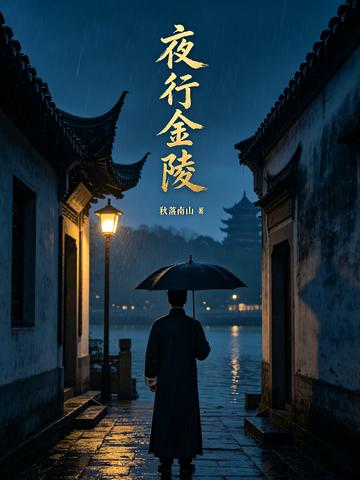
In Nanjing during the Republic of China, flower-picking cases occurred one after another in the south of the city. The techniques were sophisticated and there were no clues. Detective Qiu Nanshan of the Capital Police Department solves crimes like a god and guides younger generations. He is a savior in the eyes of everyone. Young detective Lu Huaijin first joined the police station and followed his master to solve strange cases repeatedly, but he vaguely felt that the cases seemed to be connected by an invisible thread. When the villain Gu Shian surfaced, all the clues began to point to the same direction - and that direction was exactly the place Lu Huaijin didn't want to see.
Reader comments
"Night Journey to Jinling" is a highly completed suspense novel of the Republic of China, which completes a serious exploration of the abyss of human nature within the framework of genre literature.
The most outstanding thing about the novel is the creation of Qiu Nanshan, a classic anti-hero. The author does not simply juxtapose "detective" and "flower thief" to create a gimmick, but uses meticulous psychological description to present the whole process of how a person is strangled by fate, marriage and his own desires, and finally slides to the moral cliff. He is not the incarnation of evil, but the product of evil - which is more chilling than the simple opposition between good and evil.
The narrative structure is also commendable. The first two volumes use Lu Huaijin's limited knowledge perspective to establish the tension between admiration and suspicion. The third volume suddenly switches to Qiu Nanshan's first-person perspective, allowing readers to repeatedly swing between "empathy" and "judgment." The interweaving of multiple perspectives in the fourth and fifth volumes pushes the tragedy to a climax. This precise control of perspective shows the author's deep grasp of the suspense genre.
In addition, the detailed restoration of Nanjing in the Republic of China (the alleys in the south of the city, Qinhuai painted boats, osmanthus cakes and sugar taro seedlings) not only creates a real historical atmosphere, but also becomes an invisible carrier of the characters' emotions. Pan Qiaolian knits a sweater, Lu Huaijin buys sugar taro seedlings—these daily actions acquire a weight beyond the ordinary as the story progresses.
If there is any regret, perhaps it is that Gu Shi'an's portrayal as the ultimate villain is a little weak, and he is more of a "symbol of evil" than an "evil person". But its flaws do not hide its merits. "Walking at Night in Jinling" uses suspense as a shell to describe the silence in marriage, the dilemma of justice, and the struggle of people to choose to go on in the darkness.
Its background is cold, but people who open the pages will feel something warm flowing in the dark.
"Night Journey to Jinling" is a highly completed suspense novel of the Republic of China, which completes a serious exploration of the abyss of human nature within the framework of genre literature. The most outstanding thing about the novel is the creation of Qiu Nanshan, a classic anti-hero. The author does not simply juxtapose "detective" and "flower thief" to create a gimmick, but uses meticulous psychological description to present the whole process of how a person is strangled by fate, marriage and his own desires, and finally slides to the moral cliff. He is not the incarnation of evil, but the product of evil - which is more chilling than the simple opposition between good and evil. The narrative structure is also commendable. The first two volumes use Lu Huaijin's limited knowledge perspective to establish the tension between admiration and suspicion. The third volume suddenly switches to Qiu Nanshan's first-person perspective, allowing readers to repeatedly swing between "empathy" and "judgment." The interweaving of multiple perspectives in the fourth and fifth volumes pushes the tragedy to a climax. This precise control of perspective shows the author's deep grasp of the suspense genre. In addition, the detailed restoration of Nanjing in the Republic of China (the alleys in the south of the city, Qinhuai painted boats, osmanthus cakes and sugar taro seedlings) not only creates a real historical atmosphere, but also becomes an invisible carrier of the characters' emotions. Pan Qiaolian knits a sweater, Lu Huaijin buys sugar taro seedlings—these daily actions acquire a weight beyond the ordinary as the story progresses. If there is any regret, perhaps it is that Gu Shi'an's portrayal as the ultimate villain is a little weak, and he is more of a "symbol of evil" than an "evil person". But its flaws do not hide its merits. "Walking at Night in Jinling" uses suspense as a shell to describe the silence in marriage, the dilemma of justice, and the struggle of people to choose to go on in the darkness. Its background is cold, but people who open the pages will feel something warm flowing in the dark.