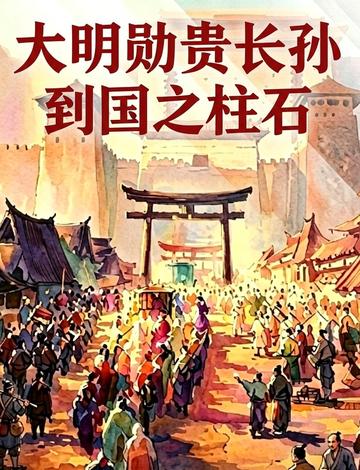
Zhang Xi traveled through the British government in the Ming Dynasty, accumulated capital and demonstrated his abilities with modern knowledge, and gained the recognition of his grandfather Zhang Fu. He also formed a deep friendship with Zhu Yi, Xu Xianzhong and other noble children. Because Zhang Xi was familiar with the history of the Ming Dynasty, he found that there was no record of himself, the eldest grandson of a British prince, in the history books. He was full of doubts and secretly determined to find out the reason. He suspected that some unknown incident caused him to "disappear" from history.
Subsequently, Zhang Xi and his father Zhang Jian were framed by Tang Saier, the leader of the hidden White Lotus Sect, and disappeared for a time. This incident further strengthened his suspicion-this may be the key point that led to his not leaving his name in the history books.
Soon after, Oara invaded, and Wang Zhen encouraged Emperor Yingzong of the Ming Dynasty Zhu Qizhen to personally conquer the army. Although Zhang Fu tried his best to dissuade him, it was to no avail because Wang Zhen was in power. Zhu Qiyu also tried to persuade him many times, but he still could not change Zhu Qizhen's decision. Zhang Xi knew that this trip was dangerous, so he persuaded Zhang Fu to leave Zhang Jian and Zhang Mao behind, while he went on the expedition with Zhang Fu. The army marched in separate directions. Due to Wang Zhen's indiscriminate command and poor decision-making along the way, Zhu Qizhen was defeated miserably in Tumubao. Zhu Qizhen was captured. Although Zhang Xi tried his best to deal with it, he failed to rewrite history.
Fortunately, Zhang Fu survived. However, because he failed to protect the emperor, he felt guilty and self-blame. After returning to Beijing, he resigned from all official positions and stayed behind closed doors. Zhang Xi had a calm mind and did not feel anxious because history had not been rewritten, nor did he stop exploring the truth about his "disappearance". Instead, he joined forces with Yu Qian and other loyal ministers, as well as Zhu Yi and others, to jointly support Zhu Qiyu in presiding over the overall situation.
Within a year, Wala saw that Zhu Qizhen had no use value, so he put it back in an attempt to provoke a struggle for imperial power within the Ming Dynasty.