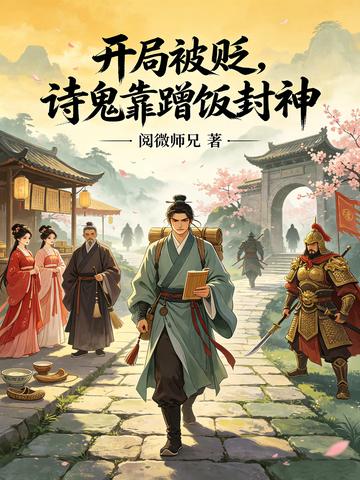
The spirit of Li He, a poet ghost, traveled through Wang Bo, a talented man in the early Tang Dynasty, who started out as a poor man who fainted from hunger and was demoted from an official position. Being penniless, he sold poems for food; he was hunted down, betrayed, and forced to go to the Peach Blossom Land, and he survived by relying on God to "give him food and life" again and again. With three beauties and a slovenly Taoist priest Li Changan, he counterattacked from a wandering poet to the master of one party, and finally joined the army with 500 soldiers and became the general of Zhennan - but every time he survived a desperate situation, he would ask the people around him: "Do you think I am a human or a ghost?"
The protagonist Wang Bo, a down-and-out scholar who fled from Shu Road, established Baiyi Village in Jiaozhi, defeated Zhao Chengye and Zhao Yixiang with the weak and the strong, and then quelled the invasion of Meng Shezhao in southern Xinjiang, and was recalled to Chang'an by Gaozong. In the court, he used three pieces of ironclad evidence and Taizong's secret decree in his father's hands to overthrow Wu Sansi, rescued Gaozong, and was named General Zhennan and Marquis of Anding. In the end, he returned to Cochin with his three wives and lived a life together. But the shadow of Wu Zetian's ascension to the throne quietly looms, and Wang Bo's future is still unknown.
Reader comments
Background of the Tang Dynasty + Soul Penetration Academic Master + Fantasy Machiavellian Strategy + Multi-line Emotions
"Being demoted at the beginning of the game, the ghost of poetry became a god by having a good meal" Baozi, who prefers the history of the Tang Dynasty, don't miss "Being demoted at the beginning of the game, the ghost of poetry became a god by having a good meal"! This book perfectly combines the turmoil of the early Tang Dynasty, the character of a talented scholar, and the thrill of counterattack. The setting of Li He's soul passing through Wang Bo's eyes is grabbed at the beginning of the book. The talented man who was supposed to be the most brilliant was once demoted to the Shu Road and fell into the bottom of his life. Hunger, pursuit, and betrayal followed one after another, and he struggled to survive in troubled times.
The author accurately grasps the historical context of the early Tang Dynasty, from the escape from Shu to the establishment of a village in Jiaozhi, from the pacification of southern Xinjiang to the court intrigues, the background of Wu Zetian's coming to the court runs through the entire story. Court games, battlefield battles, and folk fireworks interweave into a magnificent picture of the Tang Dynasty. The protagonist uses poetry as a blade and wisdom as a strategy, and counterattacks and rises in a desperate situation. He has the arrogant talent of a "poetry ghost" and the tenacity to survive in troubled times. The first-person narrative allows readers to immerse themselves in his ups and downs and glory, and the bond between his confidante and his best friends is warm and touching. It has a rich sense of history and a sense of counterattack, and the writing is delicate and smooth. After reading it, you feel like you have experienced an epic of the troubled times of the Tang Dynasty. It is full of stamina!
Background of the Tang Dynasty + Soul Penetration Academic Master + Fantasy Machiavellian Strategy + Multi-line Emotions "Being demoted at the beginning of the game, the ghost of poetry became a god by having a good meal" Baozi, who prefers the history of the Tang Dynasty, don't miss "Being demoted at the beginning of the game, the ghost of poetry became a god by having a good meal"! This book perfectly combines the turmoil of the early Tang Dynasty, the character of a talented scholar, and the thrill of counterattack. The setting of Li He's soul passing through Wang Bo's eyes is grabbed at the beginning of the book. The talented man who was supposed to be the most brilliant was once demoted to the Shu Road and fell into the bottom of his life. Hunger, pursuit, and betrayal followed one after another, and he struggled to survive in troubled times. The author accurately grasps the historical context of the early Tang Dynasty, from the escape from Shu to the establishment of a village in Jiaozhi, from the pacification of southern Xinjiang to the court intrigues, the background of Wu Zetian's coming to the court runs through the entire story. Court games, battlefield battles, and folk fireworks interweave into a magnificent picture of the Tang Dynasty. The protagonist uses poetry as a blade and wisdom as a strategy, and counterattacks and rises in a desperate situation. He has the arrogant talent of a "poetry ghost" and the tenacity to survive in troubled times. The first-person narrative allows readers to immerse themselves in his ups and downs and glory, and the bond between his confidante and his best friends is warm and touching. It has a rich sense of history and a sense of counterattack, and the writing is delicate and smooth. After reading it, you feel like you have experienced an epic of the troubled times of the Tang Dynasty. It is full of stamina!