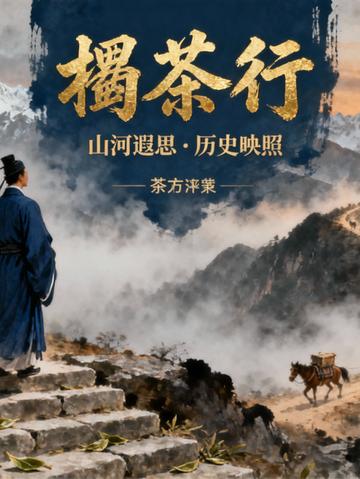
In the seventh year of Xining, the Song Dynasty court implemented the new tea-horse law and exchanged Shu tea for border horses, hoping to strengthen the northwest border defense and check and balance the Xixia cavalry.
Su Weiqing, 27 years old, was born as a Jinshi. Because his outspoken words offended the powerful, he was exiled to Shu. He was appointed to promote tea and horse officials to official duties, and was ordered to preside over the Sichuan-Shaanxi tea and horse trade.
With a piece of appointment in hand, he set out from Bianjing and embarked on the ancient road to Shu. The difficulty of the road to Shu is to reach the blue sky - the plank road hangs on the cliff, the clouds and mist of the Qinling Mountains lock the valley, and the sound of horse hooves is heard when the sword gate is closed. Along the way, he saw porters bending into bows and carrying the entire imperial court's western frontier defense line with their flesh and blood; he saw tea merchants colluding with the government and turning the imperial court's order to sell tea into a tool for enriching their own pockets; he also saw the eyes of the Tibetan leaders waiting to change horses at the foot of the snow-capped mountains - in those eyes, there was both a desire for Han tea and an examination of the sincerity of the Song Dynasty.
From Chengdu to Yazhou, from Diaomen Pass to the ancient city of Songzhou, Su Weiqing walked through every mountain and river and walked into every fold of history. The Ancient Tea Horse Road is not just a trade route, it is the thinnest and strongest line between the Song Dynasty and the various ethnic groups in the southwest. If it is interrupted, the frontiers will be in turmoil; if it is continued, the mountains and rivers will be safe.
And what he has to do is to hold this line amidst the wave of reforms, the calculations of merchants, and the strife of the court.
The reverie of mountains and rivers is guided by tea; the reflection of history is evidenced by Tao.