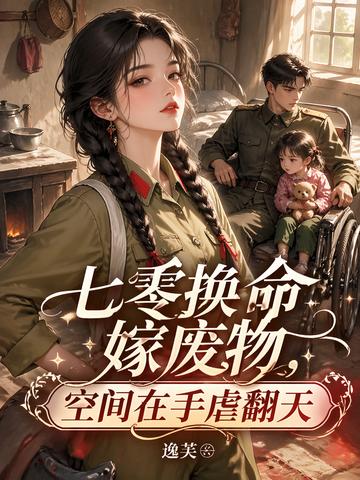
In 1975, Su Tang opens her eyes to find herself in the body of a young educated woman who was sold by her own mother to a poor mountain village in exchange for a bride price.
Her mother used Su Tang's assignment to the countryside to get her own daughter a city job, then sent Su Tang in her place to marry a paralyzed soldier as a good-luck bride.
The woman whose body she now occupies had been worked to death by the stove at her in-laws' home, leaving behind a three-year-old mute daughter.
Her stepmother-in-law plans to give the child away in exchange for food, while her brother-in-law treats her like a free servant.
And her paralyzed husband? The whole village says he's useless and waiting to die!
On her first day, Su Tang flips the kitchen upside down and beats her stepmother-in-law, who stole her food rations, into the pigpen.
On the second day, she discovers her paralyzed husband was injured on a top-secret mission and is a highly decorated hero, with a rank even higher than a regiment commander.
On the third day, she unlocks a portable medicinal garden dimension where spiritual spring water can cure all kinds of illnesses.
She drives in a silver needle, and her “useless” husband's finger moves.
When the entire village falls to its knees begging her to treat them, she smiles. “Who was it who said they'd give my child away?”
While the “real educated youth,” the daughter who took Su Tang's place, is living it up in the city, Su Tang has already cured her husband and moved with him and their daughter into the military compound.
Her father-in-law, a senior officer, looks at his granddaughter's face. “This child… she looks like the descendant of my fallen comrade-in-arms!”
Her mother panics.
I just like this story, but I didn't understand the part about the heroine's grandfather. Obviously the old chief said that the heroine's grandfather had died a long time ago, but he didn't die in the end. The father's story was okay and could be rounded up. There was also an introduction, which said that the chief's father-in-law saw his granddaughter. Like his comrades. Then my mother panicked, but the book said it was the old chief. And I still saw the heroine say it. It's so twisted, with several story directions. The directions are different, but they are all written in the same book, and they are written cross-wise. It is really twisted. If it really doesn't work, wouldn't it be okay to separate out a few of them? Does it have to be written in a book? The heroine's grandfather died for a while and then stayed alive. There is also the issue of the male protagonist's hometown, which is dealt with once in a while. If there is only one story direction, I hope it will be the one where grandpa has sacrificed his life. It's not that grandpa is still alive and has another wife and children. I still hope that grandpa will still be the same old hero in everyone's mind. I really hope that my father is not dead and can come back alive to support the heroine. Although maybe the heroine doesn't need this backer.
There are some duplications but the internal customers are okay
OK, the hero has stood up and his daughter can speak.
The company commander is not the battalion commander
It's very well written, and it makes people feel sad to read it. It makes people feel sad when they read it, and those who have experienced it will work hard to ask questions.
Nice! Fascinating!!
What a brave little fish