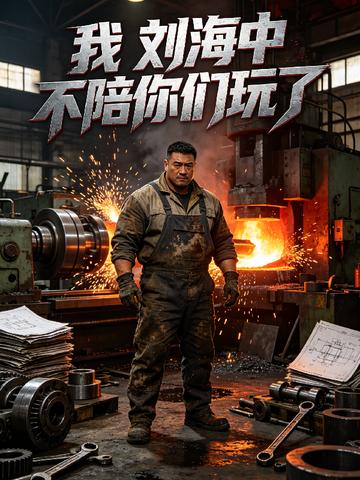
In the courtyard house of Peking in 1950, blacksmith Liu Haizhong ushered in a new life due to a high fever. While others were still fussing over trivial calculations, he had already set his sights on the gas cans in the scrap heap.
From home-made artillery that shocked the Forty-Nine Cities, to military industry research to resist U. S. Aggression and aid Korea, from workshop innovation in the First Five-Year Plan, to technical disaster relief in difficult times, Liu Haizhong always held the hammer in his hand and immersed himself in making things in the tide of the times.
He was too lazy to get involved with the parents in the courtyard, and he laughed off the villains' petty quarrels. The deaf old lady was morally kidnapped, so he took out his military industrial certificate; Yi Zhonghai was technically provocative, so he spoke with his tempering process; Jia Zhang was acting mischievously, so he turned around and went into the backyard to make inventions.
He taught his son how to read blueprints, recognize herbal medicine, and practice calligraphy, turning his skills into family strength. He led his apprentices to innovate, enter the market, and set up factories, bringing local craftsmanship to the world.
When the people in the courtyard were still trapped in the quagmire of shortcomings, Liu Haizhong was already riding his bicycle to the machinery factory in the suburbs of Beijing; when Bangge was still bragging about his life in the alley, his sons had become the backbone of the enterprise.
After forty years of ups and downs, from forger to factory director, from gas tank to CNC machine tool, Liu Haizhong used his hands to make a life that was incomprehensible to the people in the courtyard.
"My bangs, I won't play with you in such trivial matters anymore."
What he wanted to build was never the three-acre plot of land in the courtyard, but his own era.
Reader comments
Technical flow, not too many bad things
The protagonist's temperament is quite palatable, except for a few flaws, logically.
Technical flow, not too many bad things
The protagonist's temperament is quite palatable, except for a few flaws, logically.