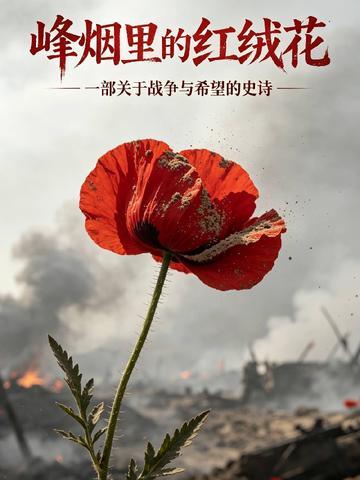
In 1938, Chun Xing, an embroiderer in Liuxi Village in North China, originally thought that her life would be as stable as the magpies she embroidered on the window lattice. Until the Japanese army entered the village, her father was killed to protect the account book that contained anti-Japanese intelligence. The blood-stained account book and half a piece of red velvet embroidery were stuffed into her arms, leaving only the sentence "Send eighteen plates, look for the person wearing the blue cloth handkerchief."
Seventeen-year-old Chun Xing embarked on her way across the blockade with an embroidery needle tempered with anesthetic. She uses her embroidery skills to hide information: dandelions are the secret code for connections, red velvet flowers represent danger, and lotus flowers represent safety. The salesman Lao Zhou taught her how to distinguish between friends and foes, and the rhythm of the cigarette stick hitting the embroidery basket was a code word; the puppet soldier Zhao Er robbed her of dry food, but when the Japanese army searched her, he hid the ledger in his gun holster and said, "I can't bear to bully a girl."
She hid behind a graveyard and used an embroidery needle to cut off the shoelaces of the pursuers, and sewed information into the cuffs of the puppet soldiers under the artillery building. In the green gauze tent, the red velvet flowers she embroidered bloomed one after another in the smoke, just like what my father said, "flowers blooming from the bones of the Chinese people."
Until I stood at the Shibapanshan Temple and saw Mr. Su, my father's former student, wearing a blue cloth handkerchief, with the other half of the red velvet flower embroidered on the corner of the handkerchief. Only then did Chun Xing understand that this flower had been split into two halves by her father, one half to protect the family and the other half to serve the country. And the thousands of flowers she embroidered have already connected into a prairie fire in the beacon smoke.