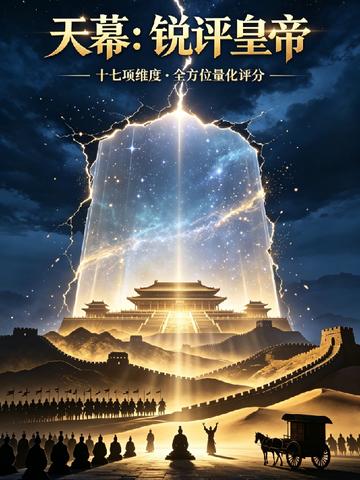
That day, the sky split open.
Tianmu will use an unprecedented evaluation system to conduct a comprehensive quantitative score for each emperor from seven major categories and seventeen scoring dimensions:
Origin and power - early experience and difficulty in gaining power. Did he start with a silver spoon in his mouth or crawl out of hell?
Regulatory longevity and historical inertia - length of reign, transfer of power, and whether the system is truly inherited by future generations?
Military and the pattern of the world—expanding territory or losing troops and territory? Will all nations come to Korea or stay in seclusion?
Political level and government affairs—system innovation, ability to centralize power, and government stability. Is he the creator or destroyer of the system?
Talent - the way of employing people, talent reserve, is it a group of bright stars or a lonely person?
Culture and technology - cultural construction and productivity promotion, are they the promoters of civilization or the burning of books and the entrapment of Confucianism?
Economy and people's livelihood - light corvee and low taxes or excessive taxation? Are the people living and working in peace and contentment, or are they living in poverty?
Each item is graded from E to S on a 15-point scale. Only those with the best history can get SSS.
Reader comments
Hello author! First of all, I want to be superficial. I am not a fan of any emperor. I am just an ordinary graduate student in history. I will express my opinions based on the historical data and archaeological data database that I know. Comments on the First Emperor lack objectivity, especially in terms of population. The population dropped significantly in the later period. From the time when the anti-Qin forces continued to launch wars after the Second Emperor succeeded to the throne to the establishment of the Han Dynasty, how many years have passed, how many wars have occurred, how many people have died, and how many years has it been since the First Emperor died? Can a dead person take the blame for this drastic reduction in population? Also, the author, historical records and archeology prove that the burning of books did not destroy the classics of various schools of thought, but was stored in the Great Qin Library. Finally, it was burned by Xiang Yu. This is not Ying Zheng's fault. He did launch large-scale corvee during his reign. There are several parts of the corvee, including soldiers, criminals who made mistakes, and common people. During the reign of the First Emperor, wages were paid, not for free. In ancient dynasties, all emperors had to do corvee, but the difference was that the difference was unpaid. Qin's laws are strict, but by no means harsh. The rebellion of Chen Sheng and Wu Guang was also triggered by the old nobles of the Six Kingdoms. Generally speaking, his biggest failure and shortcoming was that he did not have a qualified successor. In the end, all the blame for the demise of the Qin Dynasty was left to him alone. All the emperors of the feudal dynasty had the shadow of Qin Shihuang's mistakes, but no one was as thoroughly hacked as he was. It is indeed both sad and lamentable! Therefore, if you want to evaluate the merits and demerits of an emperor, you should use the history closest to the truth to objectively evaluate it.
Hello author! First of all, I want to be superficial. I am not a fan of any emperor. I am just an ordinary graduate student in history. I will express my opinions based on the historical data and archaeological data database that I know. Comments on the First Emperor lack objectivity, especially in terms of population. The population dropped significantly in the later period. From the time when the anti-Qin forces continued to launch wars after the Second Emperor succeeded to the throne to the establishment of the Han Dynasty, how many years have passed, how many wars have occurred, how many people have died, and how many years has it been since the First Emperor died? Can a dead person take the blame for this drastic reduction in population? Also, the author, historical records and archeology prove that the burning of books did not destroy the classics of various schools of thought, but was stored in the Great Qin Library. Finally, it was burned by Xiang Yu. This is not Ying Zheng's fault. He did launch large-scale corvee during his reign. There are several parts of the corvee, including soldiers, criminals who made mistakes, and common people. During the reign of the First Emperor, wages were paid, not for free. In ancient dynasties, all emperors had to do corvee, but the difference was that the difference was unpaid. Qin's laws are strict, but by no means harsh. The rebellion of Chen Sheng and Wu Guang was also triggered by the old nobles of the Six Kingdoms. Generally speaking, his biggest failure and shortcoming was that he did not have a qualified successor. In the end, all the blame for the demise of the Qin Dynasty was left to him alone. All the emperors of the feudal dynasty had the shadow of Qin Shihuang's mistakes, but no one was as thoroughly hacked as he was. It is indeed both sad and lamentable! Therefore, if you want to evaluate the merits and demerits of an emperor, you should use the history closest to the truth to objectively evaluate it.