The mists of Chongqing can conceal ghosts, but they cannot conceal the human heart.
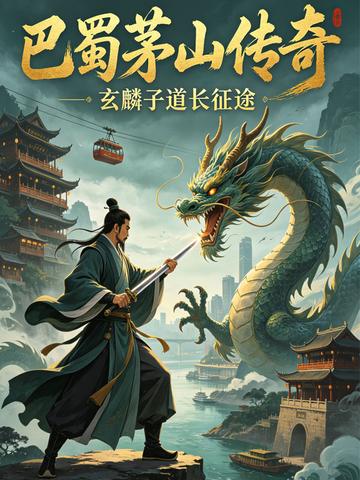
Xuan Linzi, a native of Yunyang, Chongqing, inherited the Zhengyi and Maoshan traditions from his family, along with the mantle of the Yuanhuang sect. Clad in a blue cloth Daoist robe, he carries his family’s peachwood sword on his back and a Six Emperors copper-coin compass in his pocket, traveling throughout Sichuan and Chongqing. His Daoist arts came from his father, a renowned local folk mage well versed in Maoshan talismans and Yuanhuang magic. Immersed in these teachings from childhood, he was rescued by talisman water after falling gravely ill at eighteen, and from then on embarked on the Daoist path. Later, he studied at Qingyang Palace in Chengdu, where an old Daoist master enlightened him with three questions. It took him eleven years to understand what he had sought all his life: to carry the Dao through his arts.
He never shies away from evil spirits and always subdues demons. Using Maoshan talismans, Yuanhuang Meishan troops, Five Thunder fire talismans, and the Black Mountain Shadow-Seizing Method, he battles heretical practitioners and contends with wicked ghosts. He enters haunted houses, explores ancient tombs, breaks evil formations, and locates dragon veins, helping the living find peace and the dead rest in peace. His stories feature chilling paranormal cases, astonishing revelations about feng shui, and, most of all, simple truths that strike at the heart:
Ghosts are not frightening. The human heart is. Feng shui is not superstition, but a way for people to live in harmony with their surroundings. Peace of mind is the greatest feng shui of all.
This is not a paranormal novel made up from nothing, but a documentary-style work based on Master Peng of Chongqing, the Daoist priest Xuan Linzi of Hong'en Temple. Every case has a real-world basis, and every talisman, hand seal, and feng shui ritual can be verified. The secret teachings of Maoshan talismans, the summoning of Yuanhuang Meishan troops, the art of divining rice in a bowl of water, and the principles of choosing burial dates: drawing on deep professional knowledge, the author presents Daoist arts as a form of wisdom that can be understood and revered.

Having skills but no way is hollow. If there is way but no skills, the skills can still be sought.
The writing is very true. The local cases and allusions mentioned by the author are all familiar to people. Are there any book friends in Sichuan and Chongqing? . .