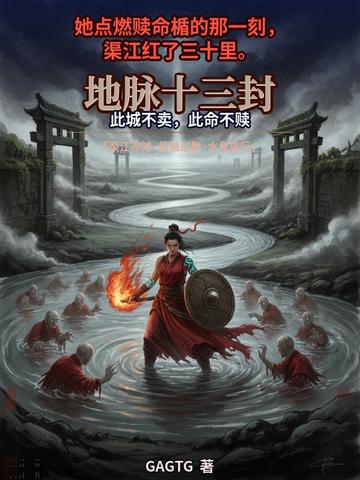
In 1243, Yu Jie built Daliang City, and the young Lu Chen carved the words, “This city is not for sale.” Thirty years later, Mongke’s campaign ended in defeat at Diaoyu Fortress. No one knew that what truly trapped the great dragon were thirteen seals on the ley lines deep within Huaying Mountain.
Lu Chen, a keykeeper who feared the light, lived underground and operated its mechanisms. Jiang Du, a river ghost chief who feared the dark, commanded the waters through the war dance of the Ba people. One lived in the mountains, the other on the river. They used “vein-song” to communicate across the water, fell in love from opposite banks, and built an underground Great Wall together.
The Yuan commander A Shu believed “everything has its price.” He tried gold, slaughter, noble titles, and death in turn, but all he got in exchange was: “This city is not for sale. This life cannot be bought back.” In 1258, Lu Chen activated the “self-entombment mechanism.” The entire city sank underground, becoming an underground kingdom that waged a thirty-year asymmetric war for sovereignty against the Yuan army.
The Song court had already surrendered, but they kept striking the rock walls in the darkness, answering “three heaps of gunpowder fire” with “three beats on the stone drum.” They held out to the last person and the last shield. In 1279, Lu Chen sealed the thirteenth gate and perished with the enemy. Seven hundred years later, an archaeological team discovered thirteen thousand bloodstained shields. The word “Not for Sale,” hammered into them, still burned bright.
Three feet beneath the earth is still the king’s land. Even in death, sovereignty does not yield.