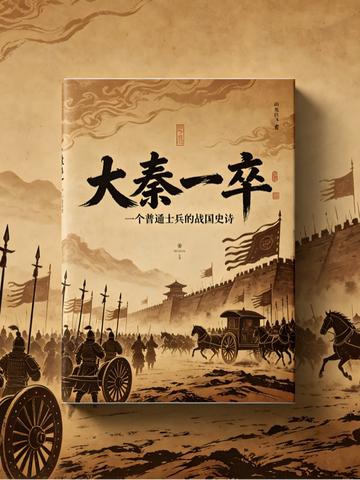
A Qin soldier's ten-year campaign, and an ordinary person's ups and downs and disillusionment in the torrent of reunification. In the seventeenth year of the Qin Dynasty, Ying He, a young farmer from Anlu County, Nanjun, was conscripted into the army. He thought he could go home after the war, but he didn't know that he would be gone for ten years.
From the first battle to destroy Han, to the bitter battle to defeat Zhao, from the destruction of Wei when the beams were flooded, to the destruction of Chu when an army of 600,000 troops poured out - he personally experienced every battle in which Qin unified the six kingdoms. He grew from a peasant boy with trembling hands holding a halberd to a fourth-level knight "Bu Geng" with outstanding military achievements. He exchanged the heads of his enemies for fields, houses, and servants, as well as scars all over his body and bloodstains that could never be washed away.
In 221 BC, the world was unified. He spent ten years fighting his way home, only to find that he could no longer return to his real home.
"The Death of Qin" is based on the true history of Qin's unification of the six kingdoms, and retells that grand process recorded in countless history books from the perspective of a small person. There are no majestic talents and strategies of emperors, generals, and ministers in the book, only the blood, fire, and death of their comrades in the eyes of the soldiers, and the remaining lives of those who were alive but had nowhere to rest after the war.
The inspiration for this book comes from the home letters of Qin Dynasty soldiers unearthed in Yunmengsuihudi. Two thousand and two hundred years ago, two Qin soldiers named Heifu and Jing wrote home - "My mother is not well" and "I have been attacking the city for a long time, and it is not wise to hurt me." Their letters, spanning two thousand years, still make people's hearts ache.
This is not only the story of Ying He, but also the story of all ordinary people who have been wiped out in history.
The old Qin Dynasty restored our rivers and mountains. There will be no truce until the blood is shed.
——But what happens after the battle?
Reader comments
It is so well written. "A Soldier of the Qin Dynasty" is about a Qin soldier's ten-year campaign, but it is a common story for all those who have been ignored by history. Ying He joined the army at the age of sixteen and experienced the destruction of Han, the defeat of Zhao, the fall of Wei, and the conquest of Chu. He exchanged the heads of his enemies for his land and title, but he could not exchange for his mother's waiting at the entrance of the village, the fact that Ah Heng was married, and a pair of hands that could hold a hoe. Black Butt died, Cripple stayed in the army, and Ying He returned to his hometown alive, only to find that he could no longer return to his real home. The novel uses the simplest white description to describe the trauma and silence of those tiny individuals behind a great unification. What you will remember after reading this is not Qin Shihuang, but an old soldier squatting on the field ridge, holding a wooden tablet, who will never farm again.
It is so well written. "A Soldier of the Qin Dynasty" is about a Qin soldier's ten-year campaign, but it is a common story for all those who have been ignored by history. Ying He joined the army at the age of sixteen and experienced the destruction of Han, the defeat of Zhao, the fall of Wei, and the conquest of Chu. He exchanged the heads of his enemies for his land and title, but he could not exchange for his mother's waiting at the entrance of the village, the fact that Ah Heng was married, and a pair of hands that could hold a hoe. Black Butt died, Cripple stayed in the army, and Ying He returned to his hometown alive, only to find that he could no longer return to his real home. The novel uses the simplest white description to describe the trauma and silence of those tiny individuals behind a great unification. What you will remember after reading this is not Qin Shihuang, but an old soldier squatting on the field ridge, holding a wooden tablet, who will never farm again.