"Only those who are crazy enough to approach a P-8A at a distance of 60 kilometers are worthy of flying this aircraft."
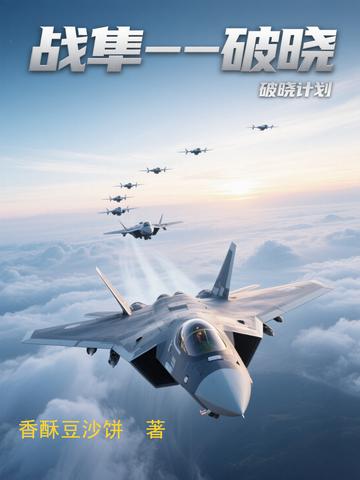
Air Force ace Lin Xiao was recruited to participate in the "Dawn Project" - testing the world's first two-seat J-20S stealth fighter. One manned aircraft and four stealth drones formed a "1+4" combat unit.
His partner in the back cabin was Su Ran who was transferred from the electronic countermeasures brigade. She had never flown a fighter jet, and the first time she sat in a simulator she threw up.
"The elimination rate is 75%."
"We may both be eliminated together, or we may... Stay together."
From the Gobi to the South China Sea, they argued in the simulator and entrusted their lives to each other when a single engine failed. When the B-21 approaches the airspace, and when the F-47 sixth-generation aircraft appears over Guam——
She used algorithms to crack the enemy's data link, and he flew the plane directly in front of the opponent.
"I used to think that air combat was about who can fire first. Now I know that it's about who can fire first so that the other side doesn't dare to take off."
It must be light. Because where they are, it's dawn.
Reader comments
This novel is wrapped in a tough mechanical shell with a delicate and touching emotional core and technical ethical thinking. The novel successfully created Lin Xiao and Su Ran, the golden couple of "front cabin and back cabin". Their arc of growth from estrangement to life and death interdependence gave the cold equipment a fiery temperature. What's even more rare is that the work deeply explores the cutting-edge proposition of the boundary of AI autonomy. Through plots such as drones losing control and electronic deception, it dialectically puts forward the combat principle of "AI is responsible for 'fast' and humans are responsible for 'right'". This is not only a novel about the iteration of weapons, but also a profound hymn to the relationship between man and machine, and to the responsibility and judgment of soldiers. It allows readers to feel the passion of air combat while also thinking deeply about the value of "people" in future wars.
This short story is based on solid military professional knowledge and provides a rigorous and rich description of advanced equipment such as the J-20S and Attack-11 as well as air combat tactics, creating a convincing future battlefield. The work is not only about technical presentation, but also focuses on the tempering and growth of characters such as Lin Xiao and Su Ran in the "Dawn Project". The running-in, trust and boundary exploration between people and AI are throughout, and the arcs of the characters are real and moving. The novel has a clear structure and advances step by step from experimental demonstration to actual combat testing. It vividly shows the process of our army's new combat force from concept to maturity. It has both a hard-core sense of science and technology and a passionate feeling for family and country.
This novel is wrapped in a tough mechanical shell with a delicate and touching emotional core and technical ethical thinking. The novel successfully created Lin Xiao and Su Ran, the golden couple of "front cabin and back cabin". Their arc of growth from estrangement to life and death interdependence gave the cold equipment a fiery temperature. What's even more rare is that the work deeply explores the cutting-edge proposition of the boundary of AI autonomy. Through plots such as drones losing control and electronic deception, it dialectically puts forward the combat principle of "AI is responsible for 'fast' and humans are responsible for 'right'". This is not only a novel about the iteration of weapons, but also a profound hymn to the relationship between man and machine, and to the responsibility and judgment of soldiers. It allows readers to feel the passion of air combat while also thinking deeply about the value of "people" in future wars.
This short story is based on solid military professional knowledge and provides a rigorous and rich description of advanced equipment such as the J-20S and Attack-11 as well as air combat tactics, creating a convincing future battlefield. The work is not only about technical presentation, but also focuses on the tempering and growth of characters such as Lin Xiao and Su Ran in the "Dawn Project". The running-in, trust and boundary exploration between people and AI are throughout, and the arcs of the characters are real and moving. The novel has a clear structure and advances step by step from experimental demonstration to actual combat testing. It vividly shows the process of our army's new combat force from concept to maturity. It has both a hard-core sense of science and technology and a passionate feeling for family and country.
This book is very nice
So far, the writing is pretty good.