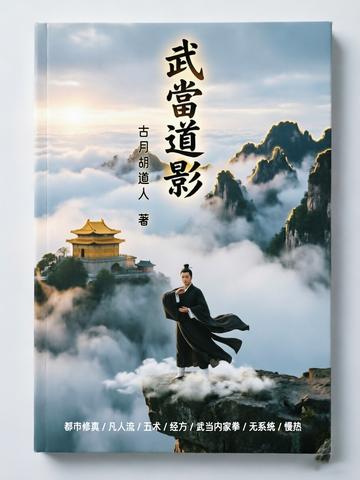
A tour guide in Wudang Mountains, relying on the prescriptions of "Treatise on Febrile Diseases" and Wudang Neijiaquan, forcibly found a way to become an immortal in the age of Dharma.
Hu Jun, a 26-year-old Wudang Mountain tour guide, has been working for three years. In the peak season, he is exhausted from leading tours. In the off-season, he sleeps in a rented house.
He thought that his understanding of this mountain was limited to the set of explanations he had memorized thousands of times.
Until a piece of stone he picked up began to heat up.
There is a picture on the stone slice - the crooked meridians, like someone's casual notes. He tried it, and there was a warmth in his Dantian, and he started walking along those lines.
The old Taoist priest on the mountain glanced at him and said: Your walking gait is a bit interesting.
My mother is ill in her hometown, and the cost of medicine has gone up again. There is news from the travel agency that the number of people will be reduced next month during the off-season.
Hu Jun had to squeeze a way between reality and practice.
He dug out the theory of Guizhi Decoction from "Treatise on Febrile Diseases" and found that the movement of qi in the prescriptions was the same as the meridian diagram on the stone tablets. He practiced the gait on the mountain road for three years. The old Taoist priest said it was called Tai Chi step.
Medicine, martial arts, fortune-telling, fortune-telling, and divination—five paths, all pointing in the same direction.
But in the Age of Ending Dharma, spiritual energy is almost exhausted. The last person to try this path was a monk from Wudang Mountain in the Ming Dynasty.
He failed.
Hu Jun stood by the cliff of Nanyan, holding the stone in his hand, watching the night fog billowing up from the valley.
He continued on the path that his predecessors had not yet completed.