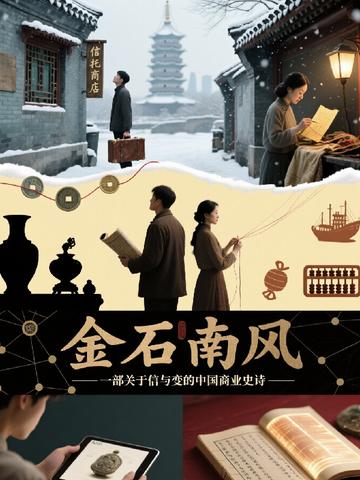
In the winter of 1978, two young people took completely different paths in the same snow.
In a Beijing alley, Lin Jianshan returned to the city from the Corps and lived in a small house with an area of nine square meters. Relying on the treasure appraisal skills taught by his grandfather during his lifetime, he worked as a temporary worker in a trust store and dealt with old objects forgotten by the times every day. When he recognized a broken bowl from the Ming Dynasty among a pile of "junk", he didn't know that this choice would push him into the undercurrent of the cultural relics world, and would also take him to the south of the Yangtze River thousands of miles away.
In her old house in Hangzhou, Shen Huaijin worked on a sewing machine day and night in a glove factory just to feed her sick mother. She is the daughter of a silk family, and there is only a library of damaged ancient books left in her family. When her mother was seriously ill, she was forced to take out a page of Song Dynasty paper she had collected and walked into a cultural relics store, where she met an old man who changed her life: "This page is worth ten yuan. But if you are willing to learn the craft of restoration, a complete Song Dynasty book can save your family."
From Beijing Hutongs to Yiwu Market, from Panjiayuan street stalls to Shenzhen Special Economic Zone, from cultural entertainment to the e-commerce wave. For forty years, he guarded the letter of "Jin Shi", and she weaved the changes of "South Wind". When fakes are rampant, capital carnivalesque, and traditions wither, can they keep their original promise - to keep the real things alive and the beautiful things to pass on?