The death of Emperor Qin II is one of the heaviest regrets in Chinese history.
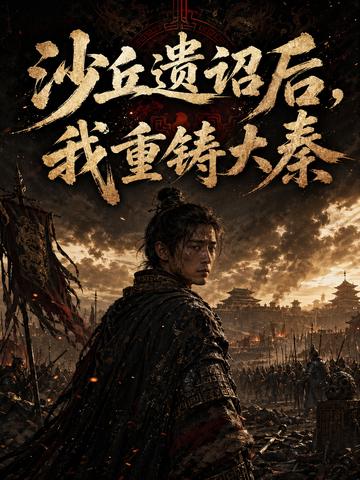
After the Shaqiu edict, the First Emperor died during his patrol. Zhao Gao and Li Si conspired to change the edict. Fu Su died, Meng Tian was imprisoned, and Hu Hai ascended to the throne. Later generations will know that he was ignorant and cruel, and finally destroyed the remaining heroes of the Sixth Generation, and thousands of miles of Qin land turned into beacon smoke.
But what if the person in his position is no longer just the Qin II who was controlled by Zhao Gao in the history books?
There are no systems, no artifacts, no industrial miracles that transcend the times. There was only a crumbling edict, a Xianyang City with turbulent undercurrents, a young emperor who was burdened with eternal infamy, and an empire that was on the verge of collapse.
He knew that Fusu could not be retained, Zhao Gao could not be trusted, Li Si could not fully trust him, and Meng could not be abandoned lightly. He also knew that the Qin Dynasty perished due to tyranny, the depletion of people's power, the failure of the system, and even more, the separation of people's hearts in the world.
From Shaqiu to Xianyang, from the false imperial edict to the reorganization of the empire, Hu Hai will re-walk the end of the Qin Dynasty in the most calm, realistic, and heavy way.
This time, he did not seek to vindicate himself, but only sought to prevent Great Qin from dying in the second generation.
Reader comments
Dear readers, thank you for your support of this book. "After the Dune Edict, I Recast the Qin Dynasty" will be updated immediately. From the initial conception to the later revision, there are some problems. Everyone's criticisms and corrections have been received and will be corrected in the future. Thank you!
I only end this novel with three sentences. First, the wheel of history rolls forward, enveloping everything. Repairing the regrets of thousands of years of history in trivial life, immersing in the experience of rich history is the joy of life. Second, Hu Hai, Zhao Gao, Li Si, and Meng Tian are all famous figures in history books. In my novels, I will show you their different lives in virtual reality. Will it also trigger your thinking about life? The third is prosperity, people suffer, death, people suffer. This book uses some inconspicuous words to address the general public. It just wants to show that the rise and fall of any dynasty is the result of public opinion (including various interest groups). To be precise, history is in the hands of ordinary people like you and me. The pursuit of excellence in life is also creating history.
Finally, I would like to thank you all for reading my book. I would like to recommend my new book "The Warring States Period: From the Lord of Jiangdong to the Hero of the Chu State", which tells the story of the concubine of King Wei of Chu who struggled to realize his ambitions during the period of King Huai of Chu and wrote a different epic of the Warring States Period. This book still adheres to heavy, logical and realistic themes. In order to make the whole plot more realistic, 329 BC (the accession of King Huai of Chu) is chosen as the starting point of the whole plot. More than ten years later, the battles of Danyang and Lantian will bend the backbone of Chu State. The protagonist is powerless but can only take his place and start a new journey of Chu State's power.
Five-star praise, please mark it with ai
The book is very good, the logic is clear, and the policy measures are logical.
The author's thinking is very clear. I just read the fourth and fifth chapters and there is no problem with the early logic. It is worth reading.
Logical thinking can
Well written and well-founded
What about posthumous titles and temple titles?
Concise and concise, the narrative is grand, and the text becomes thicker and heavier as it goes on!
Dear readers, thank you for your support of this book. "After the Dune Edict, I Recast the Qin Dynasty" will be updated immediately. From the initial conception to the later revision, there are some problems. Everyone's criticisms and corrections have been received and will be corrected in the future. Thank you! I only end this novel with three sentences. First, the wheel of history rolls forward, enveloping everything. Repairing the regrets of thousands of years of history in trivial life, immersing in the experience of rich history is the joy of life. Second, Hu Hai, Zhao Gao, Li Si, and Meng Tian are all famous figures in history books. In my novels, I will show you their different lives in virtual reality. Will it also trigger your thinking about life? The third is prosperity, people suffer, death, people suffer. This book uses some inconspicuous words to address the general public. It just wants to show that the rise and fall of any dynasty is the result of public opinion (including various interest groups). To be precise, history is in the hands of ordinary people like you and me. The pursuit of excellence in life is also creating history. Finally, I would like to thank you all for reading my book. I would like to recommend my new book "The Warring States Period: From the Lord of Jiangdong to the Hero of the Chu State", which tells the story of the concubine of King Wei of Chu who struggled to realize his ambitions during the period of King Huai of Chu and wrote a different epic of the Warring States Period. This book still adheres to heavy, logical and realistic themes. In order to make the whole plot more realistic, 329 BC (the accession of King Huai of Chu) is chosen as the starting point of the whole plot. More than ten years later, the battles of Danyang and Lantian will bend the backbone of Chu State. The protagonist is powerless but can only take his place and start a new journey of Chu State's power.
Five-star praise, please mark it with ai
The book is very good, the logic is clear, and the policy measures are logical.
The author's thinking is very clear. I just read the fourth and fifth chapters and there is no problem with the early logic. It is worth reading.
Logical thinking can
Well written and well-founded
What about posthumous titles and temple titles?
Concise and concise, the narrative is grand, and the text becomes thicker and heavier as it goes on!