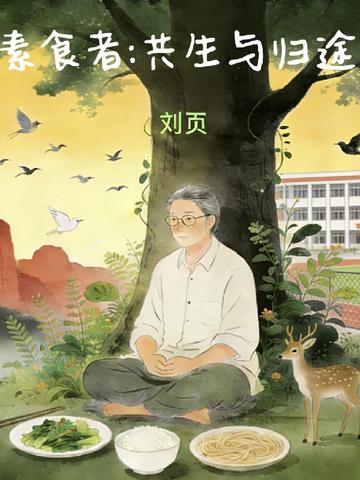
The Vegetarian tells the story of Ayuan, a young man from Inner Mongolia who heads south to Shaoguan, Guangdong, in 2008 to teach. With “vegetarianism” as its central metaphor, the novel portrays the struggle of an idealist trying to survive in the narrow space between his ideals and reality.
Ayuan earns a monthly salary of 1,487 yuan as a teacher and lives in a disused laboratory. He subsists on plain congee and pickles, yet sends 1,000 yuan back to his family in the north. In precise, unsentimental prose, the author records the ledger of his life: a 15-square-meter room, a rusty coal stove, a knife worn blunt. Amid material deprivation, he builds an inner order. He is a “producer” of knowledge, a “decomposer” of loneliness, and a “migratory bird” in an era of change: a wild goose flying south, fleeing his frozen homeland only to confront anxiety over finding his place in the ecosystem of the hot, humid south.
The novel breaks with the hopeful tone of traditional stories about education. Through images such as a “blood-red sunset” and “paramecia under a microscope,” it portrays an individual’s struggle against the urban-rural divide and the weight of responsibility to the next generation. Ayuan’s vegetarianism is not a dietary choice but an existential act of resistance. When “remember to send money” becomes the last words his mother mouths to him, he does what he can to preserve his dignity and his family bonds, protecting the intellectual’s spiritual principles amid the flood of consumerism.
Good philosophies about living things