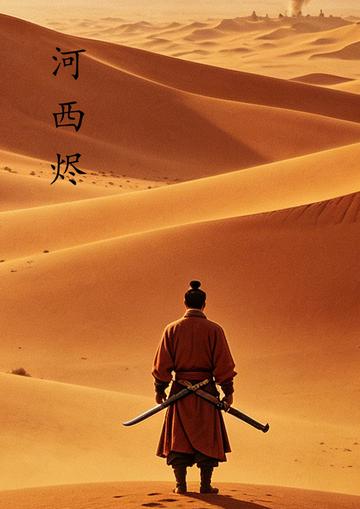
In 830 AD, Zhao Yi was born in a place called Huangqugou outside Shazhou City. His family makes a living by herding sheep, and Ayin's family next door has a vineyard.
Tubo ruled Hexi for more than sixty years, and the Han people were exploited like livestock. When Zhao Yi was fifteen years old, the Tibetan soldiers increased the number of sheep in his family from ten to fifteen. His father couldn't make up the number and knelt in the mud. Zhao Yi will remember the cry of the ewe carrying the lamb for the rest of his life.
At the age of eighteen, Zhang Yichao raised the flag in Shazhou. Zhao Yi applied for the army. Before leaving, Ayin tied a red-headed rope around his wrist: "Just come back alive."
He's back. But the road to the Yijun was longer than any Gobi road he had ever walked.
From Zhang Yichao to Zhang Huaishen to Zhang Chengfeng, from the Guiyi Army to the Jinshan Kingdom, from its prosperity to its destruction. During the sixty-two years, Zhao Yi worked as a messenger, a soldier, was injured, and retired to the logistics. He sent away Zhang Yichao's back, sent away Ayin, and sent away all his comrades. In the end, he was the only one left, living in an adobe house in Huangqugou, raising a few sheep, and counting them like his father.
The first character Ayin taught him to write was "Zhao". He carved his life's events on the wooden board - Sheep Tax, Kneeling, Candy, Red Headband, Zhang Yichao and Wu Zhen.
The last word is "Jin".
This is not a story about emperors and generals. This is the story of a Hexi herdsman who herded sheep and spent his life witnessing a regime burnt from flames to ashes.
The wind and sand were still blowing, and no one came to open the door.
But the carved boards are still there - if anyone finds them.