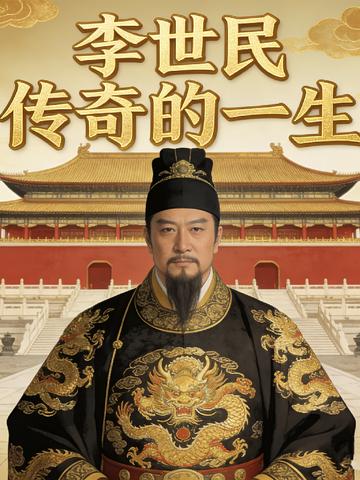
A sign of two dragons appeared at his birth, and a wandering Daoist left behind a twelve-character prophecy: “The bearing of a dragon and phoenix, the countenance of the sun. Before the age of twenty, he will surely bring peace and prosperity to the people.” No one imagined that this child, named “Shimin,” would personally bury an empire thirty years later, then build an unprecedented golden age on its ruins.
At nineteen, he urged his father to rise in rebellion. At twenty, he was made Prince of Qin. At twenty-four, he crushed a hundred thousand enemy troops at Hulao Pass with three thousand Black Armored Cavalry, pacifying the Central Plains in one fell swoop. He was a prodigy on the battlefield and a gambler who put everything on the line in the game of political intrigue. On the night of Xuanwu Gate, he and his elder brother Li Jiancheng went from brothers to mortal enemies. The arrow pierced more than flesh and blood: it also severed thirty years of brotherhood. After that night, he knelt before his blood-soaked father and wept like a child.
But his tears did not stop him from becoming a wise ruler of his age.
In the twenty-third year of Zhenguan, with a reverence for the words “Water can carry a boat, but it can also overturn it,” he ushered in the most brilliant era of governance in Chinese history: Fang Xuanling's planning and Du Ruhui's decisiveness, taking others as mirrors, the twenty-four meritorious officials of the Lingyan Pavilion, and recognition by the surrounding lands as the “Heavenly Khan.” He also endured the heart-rending pain of deposing and replacing the crown prince, and in his later years wrote the "Emperor's Rules" with tears in his eyes for his successor.
This is a story of choices, betrayal, glory, and loneliness. The life of an emperor is also a mirror reflecting human nature and fate.
He is Li Shimin. He is the protagonist of his own story, and his elder brother's mortal enemy.