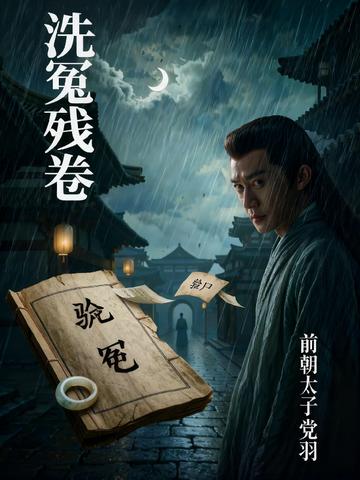
In the first year of Yuanyou in the Northern Song Dynasty, Shen Moyan, a student of Taipei University, was expelled from his academic career and lived on the street because he openly questioned the "judgment of ghosts and gods" during his studies.
All he had in his hands was a mutilated copy of "The Redress of Injustice" and a last word left by his father: "Evidence doesn't lie, but people do."
Soon, the Minister of Rites died suddenly and mysteriously. He was bleeding from his orifices but was smiling. Dali Temple hastily concluded the case with "ghosts and gods demanding life". Shen Moyan broke into Dali Temple to point out doubts and was kicked out, but attracted the attention of the hot-blooded young minister Zhao Yuanqing.
The two teamed up to conduct a secret autopsy and found that the deceased did not die from a curse, but from a rare and strange poison called "Hanxiaosan". As the investigation deepened, three corpses, a poem manuscript, and an old grudge about the Wutai Poetry Case that had been buried in dust for twenty years gradually surfaced.
This is not simple revenge, but a carefully planned purge. There is more than one murderer, and the mastermind behind the murder is directed at the court.
Shen Moyan must use his methods - autopsy, verification, reasoning - to read the truth from the scars on the corpse, and tear open a ray of light in the cage woven by power and superstition.
But as he got closer and closer to the truth, he discovered that what he was investigating was not the case, but the people's hearts; what he was fighting was not the murderer, but the entire era.
Evidence doesn't lie, but does the truth really matter?