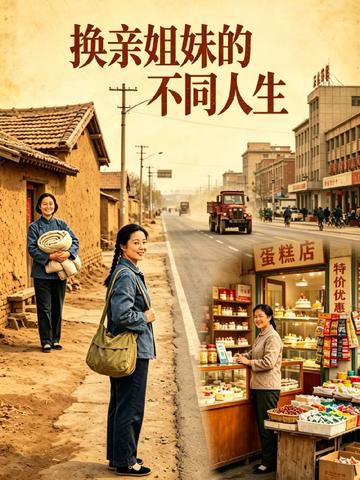
The story takes place in a production brigade in the North China Plain, where household quotas have just been implemented for two years. Although there is a surplus of grain, there is little cash. In the 1970s and 1980s, especially in remote areas, many school-age boys from poor families had difficulty finding a suitable partner, so they used their own daughters to exchange their sons for a wife, which is a marriage exchange. There are two main forms of marriage exchange: two exchanges and three exchanges. The second exchange is the exchange of the sons and daughters of Zhang and Wang's families and they become in-laws; the third exchange is the exchange of the sons and daughters of Zhang, Wang and Zhao's three families, the combination of Zhang's male and Wang's daughter, Zhang's daughter and Zhao's male, and Wang's and Zhao's daughter. At that time, marriage exchange did solve many people's marriage problems for older men; but there was another special form of marriage exchange, which was the union of two girls from one family and a boy from two families. Most of these families were remarried families. The stepmother would use the stepdaughter's marriage to exchange for the happy life of her biological daughter, causing countless girls who had no support to endure both physical and mental harm. This book tells the story of a 19-year-old girl named Lin Maisui. In order for her half-sister Lin Zhaodi to marry Zhao Xiaojun, the son of the director of the supply and marketing cooperative, she was forced by her stepmother to marry Zhao Xiaojun's cousin, a 28-year-old Lu Shiyan who was lame in one leg. But Liu Cuihua never expected that the life of the two sisters after marriage would hit her hard in the face. At any rate, through hard work, I finally lived a happy life that everyone envied.