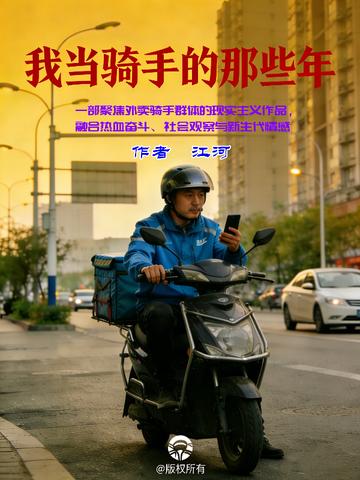
Qiao Wei, a former AI engineer at a major factory, became a scapegoat due to an algorithm accident. He fell from the high-paid elite to the bottom, and became a food delivery rider who was coerced by the algorithm. He personally experienced the cruelty of overtime deductions, malicious negative reviews, and ignored health warnings. He witnessed countless riders overdrawing their lives under the squeeze of the platform algorithm. He even unexpectedly discovered the shocking secret left by the site elder K - 137 rider death records, the backdoor code of the platform algorithm, and the dark truth that the algorithm deliberately "optimized and eliminated" high-risk riders.
Relying on top technology, Qiao Wei reversely cracked the platform algorithm, formed a "ghost team" for mutual aid among riders, built a decentralized resistance network, and launched a fierce battle on three fronts: technology, law, and public opinion against capital-controlled algorithms. From surviving alone to leading thousands of riders to fight, he exposed the platform's monopoly, promoted algorithm accountability legislation, and finally created a rider autonomy platform, allowing bottom workers in the digital age to break free from their shackles and use technology and solidarity to rewrite their dominated destiny. This is an epic of urban workers that focuses on the survival plight of delivery riders and combines realistic criticism and passionate struggle.
Reader comments
After crashing on a rainy night, Qiao Wei flew out and slid two or three meters. His first reaction was to check his mobile phone - the conditioned reflex of contemporary riders: people can be injured, but one cannot overtake him. The system prompts "Abnormal stationarity detected" and asks if it is an accident. Select "Yes" to start the insurance process, and select "No" to continue delivery - this design made the Nobel Prize winner in economics silent after seeing it, taking the "rational man hypothesis" to the extreme. What's even more bizarre is the insurance clause "No compensation for unilateral accidents" - there is no third party responsible for a car crash? Blame it on yourself, deduct the money. The medical expenses are 250 yuan, the income is 48.4 Yuan, and the hourly wage is 4.4 Yuan. The black slaves shook their heads after seeing this cost-effectiveness. Old K delivered medicine and USB flash drives late at night, 137 death records - this is not data, it is the brokenness of 137 families. It is recommended that this chapter be renamed "About the incident when I crashed the car and discovered that the system was killing people in batches".
After crashing on a rainy night, Qiao Wei flew out and slid two or three meters. His first reaction was to check his mobile phone - the conditioned reflex of contemporary riders: people can be injured, but one cannot overtake him. The system prompts "Abnormal stationarity detected" and asks if it is an accident. Select "Yes" to start the insurance process, and select "No" to continue delivery - this design made the Nobel Prize winner in economics silent after seeing it, taking the "rational man hypothesis" to the extreme. What's even more bizarre is the insurance clause "No compensation for unilateral accidents" - there is no third party responsible for a car crash? Blame it on yourself, deduct the money. The medical expenses are 250 yuan, the income is 48.4 Yuan, and the hourly wage is 4.4 Yuan. The black slaves shook their heads after seeing this cost-effectiveness. Old K delivered medicine and USB flash drives late at night, 137 death records - this is not data, it is the brokenness of 137 families. It is recommended that this chapter be renamed "About the incident when I crashed the car and discovered that the system was killing people in batches".