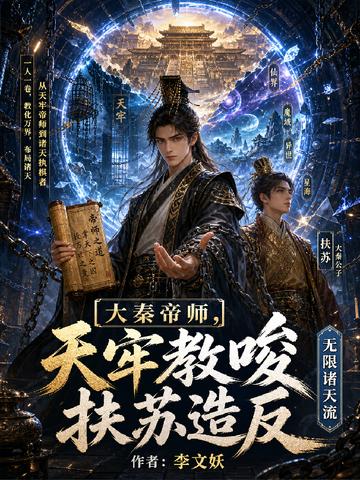
Emperor Qin's Master, Tianlao Instigated Fusu's Rebellion
大秦帝师,天牢教唆扶苏造反
- Status
- Ongoing
- Length
- 705k Words
- Genre
- Historical
- Subgenre
- Historical High-Concept
- Audience
- Male
- Updated
- 1mo ago
- Source
- Fanqie
Stats
28kReads
7.9Score
3.2kShelves
318Chapters
7.4kListens
452.8kReads · all time
Tags
Synopsis
Reader comments
In booklists 3
Top-Notch Book, Very Mouth-Watering, Don't Read If You Don't Have a Good Book.
293.4MViews579Books10hUpdated
I'm Tired of the Plot Being Too Cliche. Feel Free to Recommend It as Long as It's a Little More Novel.
16MViews576Books1dUpdated
Which Book Will Be the Biggest Hit This Year?
I want to read a book similar to "Fighting to Build the Road to Heaven". I always pay attention to the integration of knowledge and interest when reading books. After reading Xian Shi's work "The Limits of the Human Body", I insist on the importance of integrating knowledge and interest. Now I am reading the author's new book "Fighting to Build the Sky Road". This book will be published in the future.
5MViews419Books1dUpdated
The angle of interpretation is very novel It's more of a didactic one, and it reads like you're listening to a lecture in class. It can be seen that the author enjoyed writing about himself [laughing evilly] Except for the content other than the main plot, some words will occasionally go back and forth. I once suspected that the author had forgotten it in the water. Big points deducted for water injection
This is a first-class book. The author provides an in-depth analysis of the people, politics, and finances of the feudal dynasty. He gives the reasons for the decline of the dynasty from the perspective of people's livelihood and the emperor. He also explains taxation and rebellion from the scholar-bureaucrat class and the landlord class. Perhaps the author did not take into account that he only repatriated young people back to their hometowns but did not allow them to grow grain. He looked forward to the subsequent reform of the court, which was destined to not be easy.
The quality is very high. I have seen a lot of Da Qin games. This one is very intense and exciting. To make sense, there are some timing issues, but it's not a big problem. Many books are simply about Li Si and Zhao Gao. This book is different. It starts from the people's livelihood and does not just focus on potatoes and grain. I only read half of it. Please read and think about it.
People who like this book will like it. The story is well written, and the knowledge it tells is well connected with the content of the novel. If you don't like it, it will feel like it's a headache and boring to watch in class. I personally like the author, come on
It's a very good "historical text". Even someone like me who's not interested in historical texts thinks it's really good. I read it yesterday and have now finished reading it (and listening to the book). Not to mention that the setting is unlimited streaming, but the writing here in Qin Dynasty is really good.
Brothers, I would like to make a suggestion. If you are not really interested in history, I suggest you not to read it. I found a small amount of plot among a large number of knowledge points, and the knowledge entered my mind in a strange way [Punch] After watching it, I feel that I can even blame Fang Qi. Anyway, I feel that the author feels comfortable writing, and doesn't care about the readers. He should first feel comfortable writing himself and then talk about it. He writes out all his thoughts in one go, but it is indeed very reasonable.
Not everyone will like this book. The author has his own thoughts on history and a background as a cultural worker. Those of us who like this book like to joke that we found a small amount of novel plot in a large amount of knowledge. It is like a "show off" work by the author. The work contains a large number of the author's evaluations of historical figures, as well as refutations and reflections on some common historical views. It feels a bit like a nagging history teacher who likes to gossip, telling you history while writing novels. But all in all, it can be called a good book. For me, who has read a lot of books in Tomato [laughs crookedly], this book is in my top ten.
The work of his immortal and my poison. It depends on whether people like it or not. I personally gave the five-star jelly grass, but some people may think it is poisonous. The author likes to talk about a lot of ideas, and I still think it is quite good and informative. Some people may not like to read long stories, and they all have their own preferences. Regarding Traveling Through the Great Qin, I dare say that the author's knowledge and ideas are already excellent and comparable to many time-traveling novels. I'm taking a look, and I'll post a rating as soon as I finish reading it or if it turns out to be toxic. In Chapter 92, the two women accepted it a bit inexplicably. There was no foreshadowing, but they were told in advance that they would accept it. Although I also like to see the harem, this description is too hasty [face covering] Moreover, the author writes that female readers will withdraw from the book. Those who want to see a river of blood will withdraw from the book. This is also the point where I saw negative reviews of the author's book. It's nothing to me. I'll take a closer look. It should be regarded as a small poisonous point.
This book cannot simply be regarded as a novel, as the plot incorporates a large number of personal historical perspectives. The author seems to be eager to express what he is thinking, the narrative and discussion are intertwined, making the reading confusing and obscure, and the story line is also slightly scattered. But if you strip away the speculative content and look at the plot itself, it is still a brilliant story.
This book is really well written. I suspect that the author has at least made achievements in history in the real world. Maybe he is a university history teacher. I am personally more interested in history, but I never have time to calm down and summarize the laws of history. I didn't expect that a random novel can bring me so much. I feel that what the author said is correct. Many of them are the author's views or opinions. You can express your opinions.
I think the author definitely enjoys the writing. But let alone refreshing, after reading The Shortcomings of Daqin, you will find all the historical novels. If you read them again, they feel childish and I don't know what they are called.
The book has its own golden house, and the book has its own Yan Ruyu. The author actually writes quite well, and expresses a lot of knowledge in simple words. Many of the most basic principles seem to be understood by everyone, but in fact they are all half-understood and cannot be explained. However, after reading the author's book, one can find that the author has written things that he seems to understand but cannot express. In fact, I think the author changed the title of the book. There will be a lot more, and those who like to read will naturally read it. I have read your book title many times on the recommendations, but I didn't click in to read it. There was really no book left, so I clicked in to take a look. Originally, I only planned to read a few chapters, but ended up seeing the latest chapter at once, but that's the case with tomatoes. The simplest and most straightforward book titles seem to attract readers, but most of them are just for reading.
The quality is really high, and it is quite rigorous. In this era of cool writing, it is also a breath of fresh air. The pa of this hegemony game is dispensable. I hope the author can keep writing. To be honest, the writing style is still a bit dry. If I polish this book a little more, I can go to the starting point to preach. I hope there will be no poisonous points in the future.
Summary: historical text (first two copies), unlimited streaming (from the third copy onwards) Generally speaking, this is not a story about fighting for hegemony. If you want to read about fighting for hegemony, you can consider whether to buy it. The first two historical dungeons are pure historical texts, not about competing for hegemony and technology. To expand strength, they are very orthodox historical texts, not about competing for hegemony. In the first two copies, you only need to focus on solving the dilemma. The way to solve the dilemma in this book is to solve the dilemma through martial arts. Then it is inevitable that various cases in history will be used to piece together the solution, and science popularization will inevitably be needed. The author cleverly uses a simple and easy-to-understand method while retaining interest to tell the plot involving historical science popularization. Most of the popular science is cleverly combined with the plot, but there are still some popular science that seems slightly "long". "Long" cannot express what the author wants to express in one explanation, so it needs to be expanded. It can be seen that the author has historical background and has his own set of understandings. It's not that "long" is bad, it's just that too long an explanation will interrupt the sense of immersion in the plot, which is a minor problem with historical writing. Next, the third dungeon that will be connected later is cut through the infinite flow dungeon, which leads to a certain sense of fragmentation in style from the previous dungeon. However, since Dungeon 3 has not yet ended, it is uncertain whether the settings of the previous protagonists will change in the subsequent plot. But for now, there are some signs. It depends on the author's future arrangements. Although it has been stated at the beginning that he will continue to experience dungeons, because the first two dungeons and the introduction of the book title are biased towards history, the following plot is fully given to readers, which is likely to be a dungeon that is biased toward historical aspects. But from the third dungeon, we can currently see that it may not only be a historical dungeon, but may also be mixed with some factors that are common in the normal infinite stream, such as the previous protagonist's divine choice, the wise man, and subsequent anomalies. As a result, its own historical attributes have been shaken, which has led to the subsequent evolution of the plot becoming uncertain. In addition, the third dungeon has raised anomalies, and the writing of weird things in the forest (similar to supernatural dungeons), etc. If the story changes completely from the third dungeon, it will inevitably lead to the loss of some readers, especially if the first two historical dungeons are both excellently written and the direction of the plot changes. But it's hard to make a conclusion before the third copy is over.
I really have a brain. This book directly breaks the stereotypes of all historical novels. It allows us to re-understand the political power and the emperor from another angle.
Not bad, more to come. At present, the angle of material selection is very novel, but due to the subject matter, I am worried about the future development of this copy of Qin Chu Han
The thinking is quite profound, and it has broadened my thinking mode in a sense. But it's quite subjective, how can I put it! It has a feeling of outline + theory + thinking. A real novel will have a sense of pictures, but this one focuses on the plot without details. It has the feeling of leading you to think about it according to the author's ideas, which is very jumpy. The good thing about it is that it breaks away from many stereotyped historical novels and gives you a refreshing feeling. When you read it, you will be like "this can still be like this" and the plot development is also very exciting. But I'm probably not good at writing characters. I think that except for the protagonist (maybe I can add Fusu), everyone is very flat. Personally, I prefer group portrait reality when looking at history. The development of this plot is too straight, without any setbacks. In fact, this is impossible. Yes, this can be said to be a cool way of writing, but the whole text shows that the protagonist's thinking is overwhelming everyone, and there is no doubt that the plot will not work without the protagonist. Believe in Han Xin, and Han Xin will never disappoint him (personally, I feel that Han Xin is a bit deviated from my understanding). No one in the court can see through his own plan. When debating scriptures, just use theory to crush them. No one will ask questions using the meaning of ancient texts. Everyone's thinking and things develop in a direction beneficial to the protagonist. (In fact, I have seen this kind of thing before! But this kind of protagonist usually has planABCD...) In addition, there are many psychological descriptions, which is both an advantage and a disadvantage. Overall, I scored 8 points on Tomato. The author is probably not a professional writer. It is already very good and needs to be polished. Come on!
The author's thinking and insights into history are very in-depth, and he is one of the few articles that carefully analyzes history. Although there are some flaws in some details (about the background of the times, it is of course possible that he borrowed from certain TV series to make it easier for some people to understand), the flaws cannot be concealed.
It took me two days to catch up. It's very good. The first two sections are very relaxing and have some educational significance. At least you can learn something from reading this book. Later, multi-player exploration became close to an endless flow. Come on, I just briefly read the first two books, which were of average quality. I could guess the plot at a glance. I didn't read it carefully, so it's definitely not as good as this one.
The author is invincible. Well, I have learned a lesson. Um, what is this called... Teaching... [Admiration] [Admiration] [Admiration] [Admiration] [Admiration] [Admiration] [Admiration] [Admiration] [Like] [Like] [Like]
After reading the latest articles, I looked at the previous points more broadly, and looked at the later arguments more carefully. I learned a lot of knowledge points. The biggest gain is that it matches my previous ideas. Thank you, teacher. I just had a lot of inspiration when I was reading it, but when it came time to write a book review, I couldn't remember any of it, which was strange. Comments on the book Xiancao, which is a historical science novel [laughs]. It teaches us a whole set of systems that have been used from ancient times to the present. Its essence is how to change the soup without changing the medicine. It is also straightforward to think deeply about the great renaissance of modern Chinese civilization. Take the essence and discard the dross. There are also the unequal treaties in the late Qing Dynasty. Isn't this a means of transferring property? Let me give you an example. Suppose you are the youngest son of a landlord. You are not qualified to receive any amount of money. The family is about to break up. Then the youngest son has found a group of robbers to cooperate. You tell the robbers where the money is hidden. After a wave of robbery, you join the gangsters to create a common cause. This was how it was when the British came. Two thousand people defeated the two hundred thousand defenders, and less than two or three hundred people died and surrendered. Later, they robbed the palace and looted it so cleanly [smile]. You should understand a lot if you check the relevant records. I also passed many questions in the postgraduate entrance examination of politics. Many people were wrong because one of the missed options was (feudal forces colluded with external forces). I remembered correctly that it was a test paper for 2025 or nearby. If you are interested, check it out yourself. After Li Hongzhang signed the unequal treaty, the Emperor of Japan even said in the newspaper that he did not expect to be compensated so much. In the blink of an eye, he immediately built a military factory. After the powers signed, You can check the unequal treaty. You can check how much the arsenal has increased when you go back. You can check the money spent after the First World War. I can say that without the unequal treaty, they would not be able to fight at all. They have no money to fight at all. And I put it plainly why the war started. It is the uneven distribution of the spoils. There are not so many triggers. The essence is the uneven distribution of the spoils.
The first two stories have a very rigorous logic, carefully analyze the shortcomings of feudal society, and provide three combined solutions. I thought it was really soul-stirring and well-written.
The shortcomings are not concealed. There are more historical political principles in the early stage, but less in the later stage. The focus is on telling the plot. The early stage makes the words "enlighten" the readers, and the later stage directly applies them. Basically, it becomes more and more enjoyable to follow the later stage. The author's writing skills are also getting better and better visible to the naked eye.
The first part is history-related content, with a more argumentative style (in short, I put some cool articles in a shell to express my own opinions), and there are more harem-like stories interspersed in the middle (about half a chapter, I mean about this much when interspersed). The latter part starts to explore (there is a shadow of Infinite Flow) and development, but it is not particularly fantasy, and it seems to be a style that wants to be combined. I think it is quite interesting, but I don't know how the author came back. I hope the author will continue to update
I feel that the research on history is very in-depth, but it is more popular science, and it is relatively less entertaining. Moreover, the wars are all covered in one stroke. If you are willing to write about it, you can actually write a little bit.
It is very rigorous and has a completely new perspective. It is the best historical article I have ever read.
It's a very good book. The author's writing style is very solid and his knowledge reserve is very high. However, I don't know if the author got too excited or because this book was not meant for readers. Suddenly, there was a big poisonous point. It was so poisonous that many people left, including me.
The writing is quite good, both in terms of writing style and plot. What I like most is the politics and royal power the author writes about. Don't understand why the rating is so low? Maybe it's because understanding it requires a certain historical and political foundation. The only thing that makes me a little painful is that every time I read a book, I need to think about the political methods for a long time, which makes me read very slowly.
In fact, it just teaches the upper level concepts of history + philosophy, which is very enlightening! Come on, author▼ᴥ▼
I read it as a good historical novel. In fact, I feel that it has nothing to do with the End Game. The author has his own opinions on political history, which benefited me a lot. It is no problem to read it just as a book about traveling through the Qin Dynasty. It is well written. I recommend it to people who like to explore political history.