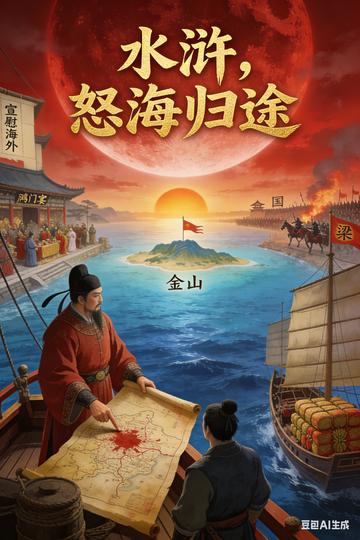
When Fangla was conquered, there were only eight generals out of a hundred, not even one of them. Faced with the imperial court's secret order to "escape the birds and hide the good bows," the surviving Liangshan brothers suddenly realized under the blood moon: there was no way for them to survive on land.
Song Jiang put away the shackles of "loyalty" and picked up the blood-stained sea map. Wu Yong's ingenuity is no longer used to gain access to the court, but to plan a stunning escape route. Li Jun's eyes cast from the Yangtze River to the boundless deep blue.
A "fake recruitment" drama for the officials of the Song Dynasty was shockingly staged at the Hongmen Banquet in Hangzhou Mansion. They used their acting skills, courage and a fictitious "plague" to defraud them of food, ships and the title of "preaching overseas".
Turning their backs to the Central Plains that was about to engulf them, Liangshan's last fire set sail. He went north to Liaodong and passed through Korea; he went south to Nanyang and fought a fierce battle against Malacca. They forged the technology of the Song people and the loyalty of Jianghu into the sword and plow of development.
When the legendary "Jinshan" continent emerges under the morning sun, when the brand-new "Liang" flag rises in a foreign land, looking back, the motherland is falling into the iron hoof of the Jin people. Returning across the sea to save the land that failed them? Or should we just turn around and build an eternal kingdom belonging to our brothers on the vast sky?
This is the last chapter and the first page of Thirty-Six Tiangang and Seventy-two Disha. This is an epic about betrayal, survival, exploration and rebirth. It is the strongest echo of the legend of Shuibo on the majestic sea.