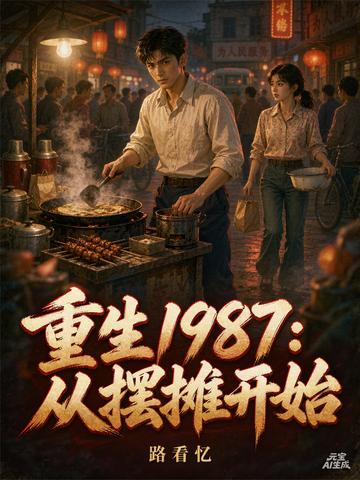
In 1987, the spring breeze of reform and opening up had just arrived in Suifenhe, on the border of northern Xinjiang.
Twenty-five-year-old Chen Anzhi came back with only 81 yuan in his pocket - his mother was critically ill in the hospital, his sister was about to drop out of school, and his father was forced by relatives to transfer his timber quota.
In his previous life, he spent forty years building a business empire worth hundreds of billions, but in exchange for it, the grass grew in front of his parents' graves and his wife and daughter were strangers to each other. In this life, he decided to start over from the market at his feet.
Others set up stalls to make a living, while he set up stalls to reduce dimensionality. Clearly marked prices, buy five and get one free, and guaranteed returns and exchanges - three rules that no one had seen at the market in 1987, allowed him to earn enough for his mother's medical expenses in one day.
Others' scalping is a desperate act, while his scalping is a precise arbitrage. The price difference between the north and the south of sugar, seasonal fluctuations in wool, and the shortage of light industry in the Soviet Union—every information gap was the starting point for his snowball.
From a street vendor in the Suifenhe market, to a bankrupt on the border, to an industrialist in the south, what Chen Anzhi wants to leave is not only the freedom of wealth, but also the perfection of his family and the dignity of a trend-setter of the times.
In this life, everything owed to him must be paid back. He wants to protect no one less.