After Zhu Bajie returned from studying in the West, Yue Lao and other immortals failed to introduce him to anyone, so he returned to Gao Lao Zhuang. He was lazy at first, but later he felt that nothing was left to him, so he opened up wasteland for farming, opened up tea gardens, built teahouses, and renovated all the houses in Gaolaozhuang. After it became a place for gods to visit, he opened a farmhouse and later changed it to a fairy resort. When Zhu Bajie's son Zhu Xiaojie grew up, he failed to study in Gaolaozhuang, so he transferred to Tianting Primary School. At the beginning. Zhu Xiaojie and Sun Wukong's son Sun Xiaokong, Bull Demon King's son Niu Xiaowang, Long Ao's son Long Xiaoao and other children made trouble in Tianting Primary School, and then gradually grew up into little fairy children who were sensible and loved to learn.
Reader comments
I think this book "The Old and the Young Are All Living Treasures" is particularly interesting!
The story revolves around the immortals who have returned from seeking Buddhist scriptures. Bajie starts a business and his old friends from all walks of life chat and play. They are a group of lovely old living treasures.
The second-generation children from all walks of life are naughty and playful, making a lot of jokes, and at the same time, they gradually learn to be sensible and grow up.
The plot is light-hearted and joyful, with no depressing plot. The two story lines of old and young are intertwined naturally, and the atmosphere of fireworks is strong. It is healing and decompressing. It is perfect for leisure reading. It is highly recommended.
This is a light and cute work, with Bajie's life after returning from Buddhist scriptures as the main line, connecting the daily fireworks of the older generation of gods with the interesting growth stories of the next generation of little fairy children. The characters are likeable and full of contrast. The fairy old live treasure Bajie returns to Gaolaozhuang and transforms from a lazy man into an entrepreneurial expert. He opens up wasteland to grow tea, opens a farmhouse, builds a resort, and turns Gaolaozhuang into a paradise for internet celebrities. Wukong Yue Lao and other old friends make guest appearances. It is full of laughter, subverts tradition, and has a serious and vivid image, full of human fireworks. Xiaobei, Fairy Boy, Xiao Huobao, Zhu Xiaojian, Sun Xiaokong, Niu Xiaowang and other second-generation stars gather to cause trouble in Tianting Elementary School. They are naughty and innocent. The growth line from naughty to sensible is lively and interesting, and the novel style of imagination is easy to cure. It breaks out of the framework of Journey to the West and focuses on the retirement life of the gods and the daily life of raising children. The plot has no cruel rhythm.
With gentle writing style, the author continues to write for us a fireworks legend beyond Journey to the West. Without the aura of Marshal Tianpeng, he is just an ordinary immortal who wants to make a home in the world. He opens up wasteland, grows tea, and repairs old houses, turning Gaolaozhuang from an ordinary village into a resort that even immortals yearn for. Zhu Xiaojie's growth line is more like a mirror, reflecting every child's childhood and transformation. Familiar characters in Journey to the West are given a new perspective, with laughter and tears, daily trivialities, and the tenderness of growth. After reading this book, you will have a long aftertaste.
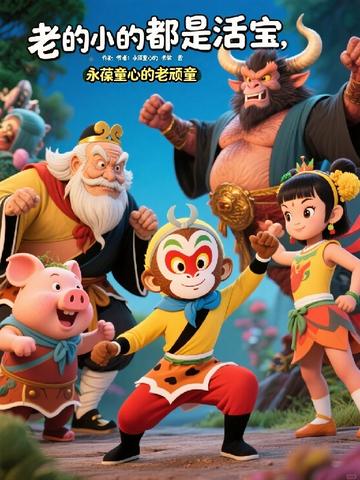
I think this book "The Old and the Young Are All Living Treasures" is particularly interesting! The story revolves around the immortals who have returned from seeking Buddhist scriptures. Bajie starts a business and his old friends from all walks of life chat and play. They are a group of lovely old living treasures. The second-generation children from all walks of life are naughty and playful, making a lot of jokes, and at the same time, they gradually learn to be sensible and grow up. The plot is light-hearted and joyful, with no depressing plot. The two story lines of old and young are intertwined naturally, and the atmosphere of fireworks is strong. It is healing and decompressing. It is perfect for leisure reading. It is highly recommended.
This is a light and cute work, with Bajie's life after returning from Buddhist scriptures as the main line, connecting the daily fireworks of the older generation of gods with the interesting growth stories of the next generation of little fairy children. The characters are likeable and full of contrast. The fairy old live treasure Bajie returns to Gaolaozhuang and transforms from a lazy man into an entrepreneurial expert. He opens up wasteland to grow tea, opens a farmhouse, builds a resort, and turns Gaolaozhuang into a paradise for internet celebrities. Wukong Yue Lao and other old friends make guest appearances. It is full of laughter, subverts tradition, and has a serious and vivid image, full of human fireworks. Xiaobei, Fairy Boy, Xiao Huobao, Zhu Xiaojian, Sun Xiaokong, Niu Xiaowang and other second-generation stars gather to cause trouble in Tianting Elementary School. They are naughty and innocent. The growth line from naughty to sensible is lively and interesting, and the novel style of imagination is easy to cure. It breaks out of the framework of Journey to the West and focuses on the retirement life of the gods and the daily life of raising children. The plot has no cruel rhythm.
With gentle writing style, the author continues to write for us a fireworks legend beyond Journey to the West. Without the aura of Marshal Tianpeng, he is just an ordinary immortal who wants to make a home in the world. He opens up wasteland, grows tea, and repairs old houses, turning Gaolaozhuang from an ordinary village into a resort that even immortals yearn for. Zhu Xiaojie's growth line is more like a mirror, reflecting every child's childhood and transformation. Familiar characters in Journey to the West are given a new perspective, with laughter and tears, daily trivialities, and the tenderness of growth. After reading this book, you will have a long aftertaste.