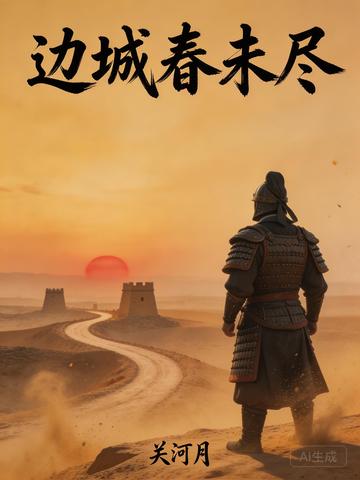
He came from later generations and woke up in a small military fortress on the frontier of Datang.
Outside the Baishi garrison, there are thousands of miles of yellow sand, post roads like lines, beacons, old post houses, remnants of business trips and letters from home that cannot be sent out, which together constitute the most silent side of the frontier in the prosperous Tang Dynasty. Han Yue learned here to carry a sword, keep vigil, and escort military supplies. He also learned to recognize people's hearts in the wind and sand, and to recognize his hometown in life and death.
There is a rough and warm brotherhood in the army, there are old tunes sung low at night, there are soldiers who still go west despite knowing that the way back is difficult to find; there is also the coldness of the system that is difficult to remember, the roster is delayed, and Chang'an is too far away.
Spring is not yet over in the border town, but conscripts are always on the way.
This is a long song about guarding the border, returning home, and the fate of the unknown: they may not be remembered in history books, but they used their flesh and blood and thoughts to keep a light that has never been extinguished for the mountains and rivers.
Reader comments
It's just a very ordinary soul travel, without any superpowers or cheating. When you come to this world, you can really only look at yourself. But here I see a strong brotherhood. The author's writing is very delicate and it is especially easy to empathize.
The author's writing style is one of the biggest highlights of this book. There is no gorgeous rhetoric, but every word is powerful and every sentence has a sense of picture. The spring in the border town has not yet ended, and the soldiers are always on the road, so the desolation and tenderness of the whole story are fully described.
The author uses the first person to thoroughly describe the coldness and warmth of the frontier - those unknown soldiers recognized their hearts in the wind and sand, and recognized their hometown in life and death. History books may not remember them, but this book keeps the light for them
I still need to review this book. I just started reading it this morning and I'm almost done with it now. From the current point of view, the writing is in-depth, describing the hardships of the frontier and the desire for survival. I hope more people will read this book, and I hope the author can calm down and slowly finish writing the story of this frontier fortress.
There are no slogans, no battles recorded in history, only the blood and flesh, wind and sand, life and death, family letters and concerns of ordinary frontier soldiers. When Han Yue, a modern man, passed through, he did not cheat to change his life, but he saw more clearly the helplessness of the border areas, and also made people see the value of those unknown soldiers more clearly.
In online articles, we are used to seeing the bloody battlefields with a grand epic feel, and the majestic feelings of family and country. It's rare for an author to pay attention to the details and write about Anxi frontier beacons, small army forts, and small soldiers with one fire and one team, and tell me their real existence in plain words.
The long descriptions of scenes, atmospheres, and details make you immersed in the story if you read it slowly. Especially since I went on business trips to Xinjiang twice this year. When I rented a car and drove on the road, I felt like I was alone in the vastness. I look forward to the author's gradual rise of the protagonist and the opening up of the Western Regions.
The writing is good and worth reading.
It's pretty good. There's no flash of swords, but it's thrilling everywhere.
The pyrotechnics and cruelty of the Tang Dynasty's frontier are brought to life. There is no battle recorded in history, only the life-and-death care between comrades and the concerns in letters home. Every supporting character has flesh and blood, and the group portraits are amazing.
The author's writing style is very delicate. In my opinion, the psychological changes of the characters and the detailed descriptions of the scenes are very good.
It's quite well written. It's a short story. It's a bit anticlimactic to end it with a dream story, and it's a bit depressing after reading it. I don't recommend reading it.
After reading too many cool articles, I finally saw an article about normal soul travel.
It is not a purely passionate war novel, nor a pure romance novel, nor a novel of pleasure, but a historical novel of "survival in a border military town + advancement of character's destiny + intertwining of family, country and personal emotions"
The male protagonist has won glory for ordinary people like us. The male protagonist has become stronger bit by bit from ordinary people. The difficulty and hardships in the process are vividly written by the author, which is delicate and touching.
The previous chapters looked okay, but I wonder if they will be unfinished.
The first few chapters are well written, I don't know if I can keep it up in the future!
It's good to tell it eloquently
Describe a soldier's heart to the bone
Very beautiful, very realistic, I feel like I am one of them
The writing is sophisticated, the plot is compact, and the psychological description is vivid. It is worth reading.
I haven't finished it yet, but I've read seven chapters. It's not a cool article. The previous article is very good, and it's very suitable for listening to books. Come on, I'll finish it.
The writing is very detailed and solid. It is a good book.
It's just a very ordinary soul travel, without any superpowers or cheating. When you come to this world, you can really only look at yourself. But here I see a strong brotherhood. The author's writing is very delicate and it is especially easy to empathize.
The author's writing style is one of the biggest highlights of this book. There is no gorgeous rhetoric, but every word is powerful and every sentence has a sense of picture. The spring in the border town has not yet ended, and the soldiers are always on the road, so the desolation and tenderness of the whole story are fully described.
The author uses the first person to thoroughly describe the coldness and warmth of the frontier - those unknown soldiers recognized their hearts in the wind and sand, and recognized their hometown in life and death. History books may not remember them, but this book keeps the light for them
I still need to review this book. I just started reading it this morning and I'm almost done with it now. From the current point of view, the writing is in-depth, describing the hardships of the frontier and the desire for survival. I hope more people will read this book, and I hope the author can calm down and slowly finish writing the story of this frontier fortress.
There are no slogans, no battles recorded in history, only the blood and flesh, wind and sand, life and death, family letters and concerns of ordinary frontier soldiers. When Han Yue, a modern man, passed through, he did not cheat to change his life, but he saw more clearly the helplessness of the border areas, and also made people see the value of those unknown soldiers more clearly.
In online articles, we are used to seeing the bloody battlefields with a grand epic feel, and the majestic feelings of family and country. It's rare for an author to pay attention to the details and write about Anxi frontier beacons, small army forts, and small soldiers with one fire and one team, and tell me their real existence in plain words.
The long descriptions of scenes, atmospheres, and details make you immersed in the story if you read it slowly. Especially since I went on business trips to Xinjiang twice this year. When I rented a car and drove on the road, I felt like I was alone in the vastness. I look forward to the author's gradual rise of the protagonist and the opening up of the Western Regions.
The writing is good and worth reading.
It's pretty good. There's no flash of swords, but it's thrilling everywhere.
The pyrotechnics and cruelty of the Tang Dynasty's frontier are brought to life. There is no battle recorded in history, only the life-and-death care between comrades and the concerns in letters home. Every supporting character has flesh and blood, and the group portraits are amazing.
The author's writing style is very delicate. In my opinion, the psychological changes of the characters and the detailed descriptions of the scenes are very good. It's quite well written. It's a short story. It's a bit anticlimactic to end it with a dream story, and it's a bit depressing after reading it. I don't recommend reading it.
After reading too many cool articles, I finally saw an article about normal soul travel. It is not a purely passionate war novel, nor a pure romance novel, nor a novel of pleasure, but a historical novel of "survival in a border military town + advancement of character's destiny + intertwining of family, country and personal emotions"
The male protagonist has won glory for ordinary people like us. The male protagonist has become stronger bit by bit from ordinary people. The difficulty and hardships in the process are vividly written by the author, which is delicate and touching.
The previous chapters looked okay, but I wonder if they will be unfinished.
The first few chapters are well written, I don't know if I can keep it up in the future!
It's good to tell it eloquently
Describe a soldier's heart to the bone
Very beautiful, very realistic, I feel like I am one of them
The writing is sophisticated, the plot is compact, and the psychological description is vivid. It is worth reading.
I haven't finished it yet, but I've read seven chapters. It's not a cool article. The previous article is very good, and it's very suitable for listening to books. Come on, I'll finish it.
The writing is very detailed and solid. It is a good book.