Li Kui's ax split not only the gate of Hujiazhuang. What it splits open is a young man's entire understanding of the world - about justice, about strength and weakness, and about what the word "hero" really means. When Hu Cheng escaped from Li Kui's axe, he finally figured it out:
The so-called hero is just a beautification theory of violence and blood; the so-called justice for heaven is just the embroidery on the butcher's knife.
This knowledge turned him from a human into a sword.
The knife has no temperature. The knife does not need justice. The knife only needs a target, a target that can pour out all the hatred. Song Jiang, Wu Yong, Li Kui,... These names have been rolling on the tip of Hu Cheng's tongue for five years, drawing out blood and cocoons, and becoming the only reason for him to live. He fled to Yan'an Prefecture and reforged himself on the Zhongjia Army's campus.
Wang Jin, the leader of the Zhong family army, taught him swords, guns and sticks, and the generals of the Zhong family army taught him tolerance. He learned very well. It was so good that I forgot that I was once a human being, so good that my father's smiling face no longer appeared in my dream, only a pool of bloody water appeared.
Some people say this is growth. I said it was a sacrifice.
Hu Cheng sacrificed himself to hatred, just as his people were sacrificed to Liangshan's "great cause".
Sobriety is painful. But pain sharpens people.
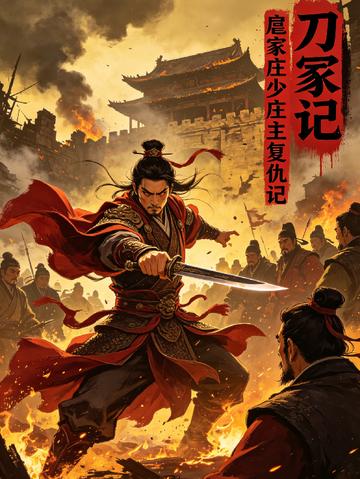
In the spring of the first year of Xuanhe, the sword was finally unsheathed.
Five hundred horses and one battalion set out from the northwest and pointed directly at Liangshan Park. Hu Cheng sat on his horse, pressed his hand on the handle of the knife, and looked at the water that once swallowed him up. There was no expression on his face, and there was no wave in his heart.
He couldn't remember the exact appearance of his father, nor could he remember the last time his sister called him "brother"
Not bad, very beautiful