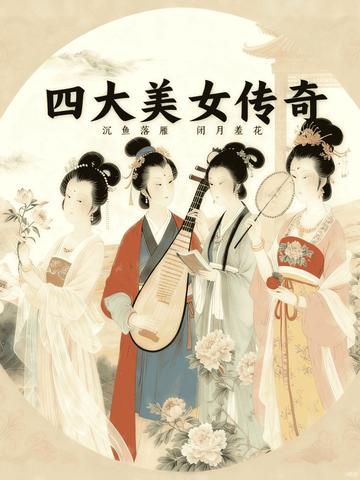
The Legend of the Four Beauties is structured in a chapter-turn format, divided into four volumes and fifty chapters to unfold the legendary lives of four peerless beauties: Xi Shi, Wang Zhaojun, Diao Chan, and Yang Yuhuan, showing their splendor and desolation in the torrent of history.
The first volume, "Xi Shi: Fish in Wansha and Sunken Fish", tells the story of the transformation of the Yue girl Xishi from the girl in Zhuluoshan to the concubine of the Wu Palace. She entered Wu as a "sinking fish" and helped Yue destroy Wu. Finally, she and Fan Li went boating on the five lakes, leaving behind eternal reveries.
The second volume, "Wang Zhaojun: The Wild Goose Falls in the Moon" depicts the heroic feat of Zhaojun, a daughter of the Han family, who went out to the fortress to get married. From a palace servant in the deep palace to a concubine on the grassland, she single-handedly maintained the peace between Han and Hungary for fifty years, left a fragrant grave in the green tombs, and witnessed the blending of civilizations with the sound of the pipa.
The third volume, "Diao Chan: The Heart is Burning after a Closed Moon," interprets a strange woman in a serial plot in the late Eastern Han Dynasty. She used her beauty to drive a wedge between Dong Zhuo and Lu Bu, and eventually led to the death of a national traitor. However, the world was in turmoil, and the ancient Buddha of Qingdeng ended his life. The mystery of "Closed Moon" is still difficult to solve.
The fourth volume, "Yang Yuhuan: Shame on a Flower, Everlasting Regret" reproduces the palace elegies of the Tang Dynasty that turned from prosperity to decline. From Concubine Shou to Concubine Yang, she was loved by three thousand people, but her soul died in Maweipo due to the Anshi Rebellion. "Song of Everlasting Sorrow" has been sung for thousands of years, leaving a sigh of "this hatred will last forever".
Four volumes of stories, four beauties, four fates - either using one's body as a sword, or using one's heart to pledge one's country, or burning one's life for righteousness, or having deep love. They write legends with their peerless grace, and also bear the fateful sadness brought by their beauty. "The fish sinks, the wild goose closes behind the moon and the flowers shy" is not only a compliment to the appearance, but also a tribute to life and a sigh of history, becoming an eternal classic image in Chinese culture.