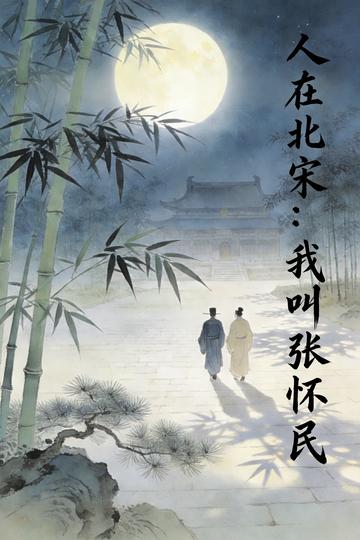
In the sixth year of Yuanfeng, Su Shi visited Chengtian Temple at night and walked with Zhang Huaimin in the atrium.
That night, a soul from nine hundred years later woke up in Zhang Huaimin's body.
He is a doctoral student in the History Department of Peking University, specializing in the institutional history of the Northern Song Dynasty. His graduation thesis was about the institutional roots of the Jingkang Revolution. He remembers all the big events. Shenzong died in 1085, Empress Dowager Gao died in 1093, Huizong ascended the throne in 1100, Jin soldiers went south in 1125, and the Jingkang Revolution occurred in 1127. He knew that the Northern Song Dynasty still had 44 years to live, and he also knew that these 44 years were his only window period.
This time, he wasn't going to stand by. This time, he wanted to change his destiny.
Starting from Huangzhou, he established a mutual aid society, promoted new agricultural methods, built dikes and dams, and gathered people's hearts. In Bianjing, he discussed Taoism with Su Shi and debated classics with Cheng Yi, sowing the seeds of change in Taixue. Going south to Jiangsu and Zhejiang, he developed overseas trade, improved gunpowder, developed firearms, and established a new army.
Twenty years later, the Jin soldiers went south and the Tiefu Tu swept across the Central Plains. But this time, what awaited them was a thunderous musket phalanx.
Destroy Xixia, pacify the Liao Kingdom, and chase the Jin people thousands of miles away. Within the four seas, they are all Song Dynasty; all the countries come to court, and the four seas become ministers.
On the day when the world was reunited, Zhang Huaimin stood at the top of Bianjing City and looked at the rising flag:
"The Song Dynasty will not perish. From today on, the owners of this land are called the people."
This is the story of a scholar who defied nature and changed his destiny to recreate China.