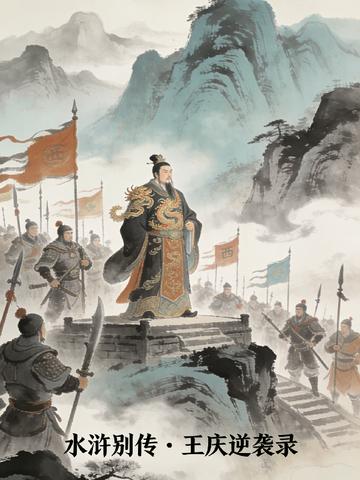
During the Xuanhe era of the Northern Song, the court was corrupt and incompetent, treacherous ministers held power, and heroes rose up across the land. Tian Hu proclaimed himself king in Jin, Hebei; Song Jiang gathered his men at Liangshan in Shandong; and Fang La held Muzhou in Jiangnan. Meanwhile, in Huaixi, a name forgotten by official histories was quietly rising.
Wang Qing, a “bandit” who appears in the original "Water Margin" only as one of Song Jiang's targets, now becomes the protagonist of this story.
He raises an army in a corner of Huaixi, with a host of fierce generals at his command: Li Zhu, the Golden Sword Master, devises strategies behind the scenes; Du Xue, commander of the Western Front, leads the three armies; Kou Mie, the Poison Flame Ghost King, wields peerless sorcery; and the Five Tigers of Jishan, the Four Braves of Longzhong, and sixty-five other generals each have their own extraordinary skills. With an army of 320,000 flying banners that blot out the sun, he brings eight prefectures and eighty-six counties under his rule.
First he proclaims himself emperor and names his kingdom Great Chu. He marches north against Tian Hu, deciding the fate of Jin in a single battle at Tianjing Pass. He campaigns east against Song Jiang, and the heroes of Liangshan Lake bow and surrender. He marches south against Fang La, capturing the bandit leader in Yuanfu Cave. Finally, he leads his troops north to lay siege to Dongjing, receives the abdication, and unifies the realm.
This is another timeline in the world of "Water Margin": the story of how an overlooked warlord defies fate, replaces the Zhao Song dynasty, and founds the Great Chu dynasty of his own.
With sixty-five mighty generals and the realm in turmoil, see how Wang Qing of Huaixi rises from humble beginnings, contends for the realm with the three great powers Song Jiang, Fang La, and Tian Hu, and ultimately claims the Central Plains.