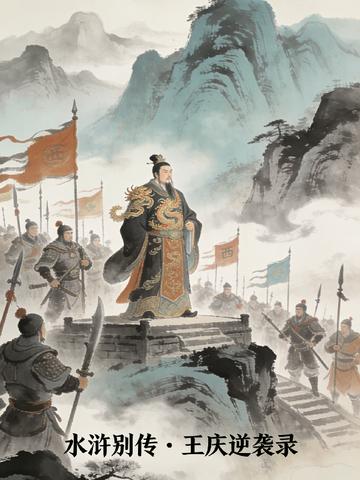
During the Xuanhe period of the Northern Song Dynasty, the imperial court was ignorant, treacherous ministers were in power, and heroes from all over the world emerged. Tian Hu in Hebei became king in the Jin Dynasty, Song Jiang in Shandong gathered in Liangshan, and La in the south of the Yangtze River defended Muzhou - but in Huaixi, a name forgotten by official history is quietly rising.
Wang Qing, the "grass bandit" who only appeared as the target of Song Jiang's conquest in the original Water Margin, has now become the protagonist of the story.
He raised his troops from a corner of Huaixi and had many powerful generals under his command: Li Zhu, the master of the Golden Sword, was planning the strategy, Du Bo, the commander of the Western Army, commanded the three armies, Kou Fan, the poisonous flame ghost king, had unparalleled sorcery skills, the Five Tigers of Jishan, the Four Brave Generals of Longzhong, and the sixty-five generals each had their own unique skills. The 320,000-strong army covered the sun with banners, and eight states and eighty-six counties were restored to the territory.
He first proclaimed himself emperor and established his country as Da Chu. Expedition to Tianhu in the north, the battle at Tianjingguan secured the Jin Dynasty; expedition to Songjiang in the east, the hero of Liangshanbo surrendered; expedition to Fangla in the south, helped capture the thieves and king in Yuandong; finally sent troops to the north, arrived in Tokyo, accepted the Zen title of emperor, and unified the world.
This is another timeline in the world of Water Margin - how a neglected hero changed his fate, replaced Zhao Song, and created his own Chu Dynasty.
Sixty-five generals, the situation is turbulent. Let's see how Wang Qing of Huaixi rises from the grass, competes with the three powerful men of Song Jiang, Fang La, and Tian Hu, and finally aspires to dominate the Central Plains.