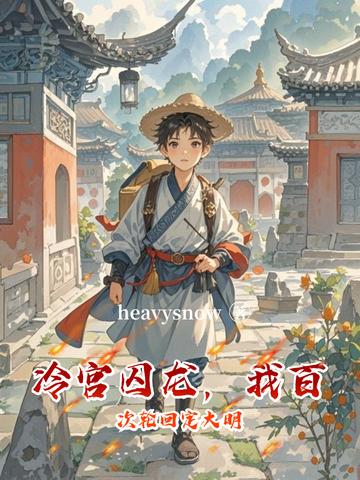
At the beginning of the game, Jing Nan Leng Palace, the seven-year-old Jianwen's direct grandson, activated the Eye of Reincarnation a hundred times!
In the first 99 reincarnations, he was either hanged by Zhu Di and killed in the cold palace, or he died in exile on a desert island.
Watching the Tumubao Incident, half a million elites were lost, Chongzhen hanged himself on Meishan Mountain, the Qing army entered the customs, and the Han civilization fell into the abyss.
In the 100th reincarnation, he will be reborn as Jing Nan!
Zhu Di's murderous intention? He could see through it at a glance and decide the life or death of Emperor Yongle in just one sentence!
The use of Jianwen's old ministers? He made a backhand plan to conquer San Yang and Yu Qian in advance, and bound future famous ministers!
He predicted all the dead ends in the Tumubao Incident, the Japanese pirate rebellion, the famine in the Little Ice Age, and the collapse of the dynasty in advance and crushed them one by one!
Don't be a caged grandson at the mercy of others, be the master behind the scenes of the Ming Dynasty!
Abolish bad government, impose sea bans, strengthen military armaments, expand territories, end all tragedies of reincarnation, and create a dynasty of all nations that far surpasses the Han and Tang dynasties!
When Zhu Di discovered that this seven-year-old child understood the emperor's mind better than him and could predict the future better than Liu Bowen, the entire Ming Dynasty chessboard had been completely overturned!
Reader comments
When we talk about the Ming Dynasty, we can't avoid Zhu Yuanzhang's iron-blooded founding of the country, Zhu Di's five conquests in Mobei, the troubles in Tumubao, Emperor Chongzhen's suicide in Meishan, and the repeated party disputes, wars, and people's dire livelihood. We always wonder, if there is one person who can return to the Ming Dynasty with the memories of future generations, can he change everything? Can this dynasty avoid the old path of prosperity and decline, and the displacement of the people?
So I wrote about Lin Mo, the King of Yan who has experienced hundreds of reincarnations.
His golden finger is not the food and guns conjured out of thin air, nor is it a system that can kill everything instantly. It is all the regrets he has seen in a hundred reincarnations: he has seen the suffering of the people under the Yongle Dynasty's military brutality, he has seen Zhu Gao Xu committed treason and died in the imperial family, saw the regret that Renxuan's rule came to an abrupt end in just ten years, saw the rise and fall of the Ming Dynasty after the Tumubao Incident, and witnessed the human tragedy of starving to death thousands of miles away and eating after changing children in the late Ming Dynasty.
After a hundred reincarnations, what he wanted most was never to sit on that dragon chair. What he wants is a Ming Dynasty that can allow people to live in peace and stability, a system that will not ruin things because of people or change orders day and night, and a truly prosperous age that can last for hundreds of years.
So I didn't write that he turned against Zhu Di at the beginning, or that he got into a verbal fight with a group of Confucians in court and slapped him in the face. What I wrote was that he implemented the New Deal step by step: opening up the sea for trade was not to show off wealth, but to enrich the national treasury and give the boatmen and merchants along the coast a way to survive; practical education was not In order to deny Confucius and Mencius, it is to open a road to heaven for the children of poor families and to cultivate officials who can do practical things for the Ming Dynasty; to promote sweet potatoes and corn, to clear out the land, to rectify water transportation, and to purge officials, all of them are not for the personal reputation of the protagonist, but for the phrase "Every household has a surplus of food, and everyone has clothes to wear."
Many people say that peacetime is not worth watching, and there must be conflict to have a plot. But I always feel that the most rare thing in history is never the ups and downs of killing and conquest, but the ordinary days of "ploughing in the spring, harvesting in the autumn, having a house to live in, and food to eat." When we look at history, we should never just look at the great achievements of emperors and generals, but also how well millions of ordinary people are living.
Of course, I also know that peace never falls from the sky. The New Deal has touched the cake of the aristocratic families and cut off the old bureaucrats' financial path. They will definitely fight back. So there is the current plot of the Jiangnan Rebellion, and there is the conflict of Zhang Jingming leading his old troops to rebel. But I never wrote about this rebellion just to write about how great it was to fight. I wanted to tell everyone: any reform or prosperity is not achieved overnight. Some people work hard to give the people a good life, while others work hard to keep their own privileges. Lin Mo's hundred reincarnations are not only to create a prosperous age, but also to maintain it.
The main line of this book has been set from the beginning: a five-volume structure, from Yongle establishing the foundation, to Renxuan Shoucheng, and then to laying a solid foundation for the Ming Dynasty for three hundred years. It will not be unfinished, it will not forcefully create a bloody plot just for the sake of conflict, and it will not let Lin Mo go to the opposite side of the people. He will always be the King of Yan who stands on the ridge of the fields or in the market, watching the fireworks in the world, and just wants to protect the safety of the people.
Finally, thank you to all the brothers who followed the update. Thank you for understanding what I wrote about "Peace in the World" and for understanding the weight of Lin Mo's sentence "The ministers are here, the Ming Dynasty is here, and the people are safe." In the following plot, I will continue to maintain this rhythm, not only to have the refreshing moments, but also to maintain this hard-won peace.
Together, we accompany Lin Mo and this Ming Dynasty, step by step, watching its rivers clear and its seas flowing, and watching it live long and peaceful year after year.
When we talk about the Ming Dynasty, we can't avoid Zhu Yuanzhang's iron-blooded founding of the country, Zhu Di's five conquests in Mobei, the troubles in Tumubao, Emperor Chongzhen's suicide in Meishan, and the repeated party disputes, wars, and people's dire livelihood. We always wonder, if there is one person who can return to the Ming Dynasty with the memories of future generations, can he change everything? Can this dynasty avoid the old path of prosperity and decline, and the displacement of the people? So I wrote about Lin Mo, the King of Yan who has experienced hundreds of reincarnations. His golden finger is not the food and guns conjured out of thin air, nor is it a system that can kill everything instantly. It is all the regrets he has seen in a hundred reincarnations: he has seen the suffering of the people under the Yongle Dynasty's military brutality, he has seen Zhu Gao Xu committed treason and died in the imperial family, saw the regret that Renxuan's rule came to an abrupt end in just ten years, saw the rise and fall of the Ming Dynasty after the Tumubao Incident, and witnessed the human tragedy of starving to death thousands of miles away and eating after changing children in the late Ming Dynasty. After a hundred reincarnations, what he wanted most was never to sit on that dragon chair. What he wants is a Ming Dynasty that can allow people to live in peace and stability, a system that will not ruin things because of people or change orders day and night, and a truly prosperous age that can last for hundreds of years. So I didn't write that he turned against Zhu Di at the beginning, or that he got into a verbal fight with a group of Confucians in court and slapped him in the face. What I wrote was that he implemented the New Deal step by step: opening up the sea for trade was not to show off wealth, but to enrich the national treasury and give the boatmen and merchants along the coast a way to survive; practical education was not In order to deny Confucius and Mencius, it is to open a road to heaven for the children of poor families and to cultivate officials who can do practical things for the Ming Dynasty; to promote sweet potatoes and corn, to clear out the land, to rectify water transportation, and to purge officials, all of them are not for the personal reputation of the protagonist, but for the phrase "Every household has a surplus of food, and everyone has clothes to wear." Many people say that peacetime is not worth watching, and there must be conflict to have a plot. But I always feel that the most rare thing in history is never the ups and downs of killing and conquest, but the ordinary days of "ploughing in the spring, harvesting in the autumn, having a house to live in, and food to eat." When we look at history, we should never just look at the great achievements of emperors and generals, but also how well millions of ordinary people are living. Of course, I also know that peace never falls from the sky. The New Deal has touched the cake of the aristocratic families and cut off the old bureaucrats' financial path. They will definitely fight back. So there is the current plot of the Jiangnan Rebellion, and there is the conflict of Zhang Jingming leading his old troops to rebel. But I never wrote about this rebellion just to write about how great it was to fight. I wanted to tell everyone: any reform or prosperity is not achieved overnight. Some people work hard to give the people a good life, while others work hard to keep their own privileges. Lin Mo's hundred reincarnations are not only to create a prosperous age, but also to maintain it. The main line of this book has been set from the beginning: a five-volume structure, from Yongle establishing the foundation, to Renxuan Shoucheng, and then to laying a solid foundation for the Ming Dynasty for three hundred years. It will not be unfinished, it will not forcefully create a bloody plot just for the sake of conflict, and it will not let Lin Mo go to the opposite side of the people. He will always be the King of Yan who stands on the ridge of the fields or in the market, watching the fireworks in the world, and just wants to protect the safety of the people. Finally, thank you to all the brothers who followed the update. Thank you for understanding what I wrote about "Peace in the World" and for understanding the weight of Lin Mo's sentence "The ministers are here, the Ming Dynasty is here, and the people are safe." In the following plot, I will continue to maintain this rhythm, not only to have the refreshing moments, but also to maintain this hard-won peace. Together, we accompany Lin Mo and this Ming Dynasty, step by step, watching its rivers clear and its seas flowing, and watching it live long and peaceful year after year.