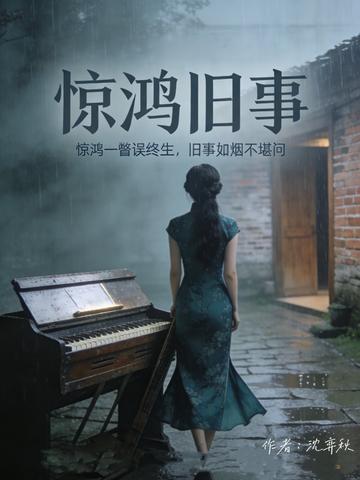
She was born unable to make out faces, and could only identify the world around her by sound.
Beneath the moon in Suzhou, he stood at the mouth of an alley and listened to her play the qin all night. She never knew. In Nanjing, she signed a marriage contract to save her father. In the fourth blank space, he wrote: You must not force her.
He told her, “Just keep playing the qin.” So she used its music to stay by his side for a lifetime.
He took the blame for her, shielded her from every storm, and bore every sorrow she could not put into words. She thought he was the young marshal, Cheng Zhiyuan, a man who could command everything with one hand. Only later did she learn that he was simply a man who could die at any moment.
He lost an arm, came back, then left again. She waited for him twice: once for three years, and once for a lifetime.
Many years later, she returned to the old family home in Suzhou. The osmanthus tree was still there, and so was the piano, but he was gone. There were no boats on the Suzhou River to carry her off in search of him. She played the piano for a lifetime and waited for the man she loved for a lifetime, but in the end, he never came back.
One fleeting glimpse can haunt you for a lifetime; old memories are like smoke, too painful to revisit. She could not remember his face, but she knew his voice. Now, there was no chance of hearing those footsteps again.