Bianliang, Northern Song dynasty. A winter night.
After closing his stall, Lin Mo, a wonton seller, gives his last bowl to a blind beggar at the mouth of an alley. It is the only thing he has learned to do in his more than twenty years of life: be kind. Kindness has never brought him any good fortune. His father died young, his mother succumbed to illness, and he himself was trampled underfoot and humiliated by the local thug Niu Er.
That night, his mother’s spirit tablet suddenly trembles. A figure steps out of a golden light: Lin Xiaoxian, an ancestor of the Lin family.
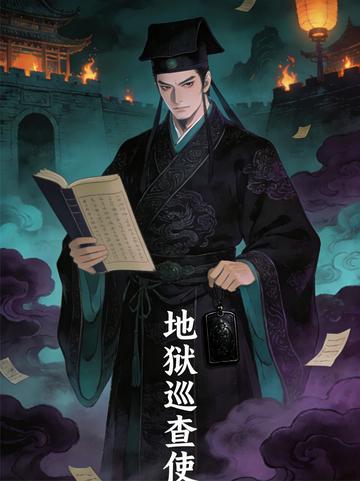
The ancestor claims to be a judge of the underworld and tells Lin Mo a startling secret: three generations of good deeds have opened the Lin family’s bloodline. From then on, Lin Mo can use the Book of Merit to see people’s sins, and the Mirror of Clearing Injustice to examine corpses and solve cases. He has only one mission: gather forty-nine utterly evil criminals, bring them to justice, and send them to Hell.
Forty-nine sinners.
Lin Mo thinks it will be easy. How can there be any shortage of wicked people in this world?
But he soon discovers that true evil is never written on someone’s face.
The kindly grain merchant Qian Wanguan gives out free porridge every year and is known as “Good Man Li,” but seventeen skeletons lie buried in his back courtyard: farmers he drove to their deaths, the youngest only three years old when he starved to death. The vegetable seller Granny Zhang, who is always smiling and giving candy to children, has abducted forty-three of them, beaten seventeen to death, and buried them in a mass grave outside the city. Then there is Wang the Butcher, who was kind to Lin Mo, often letting him buy meat on credit and giving him offal during holidays, yet dismembered seven vagrants in his own backyard and mixed their flesh with pork to sell.
Behind every smiling face lies a Hell.











Well written and very true. Very humane.