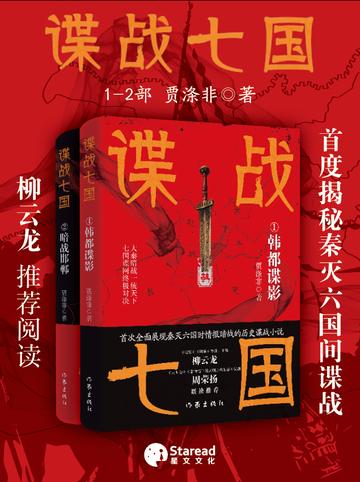
For the first time, it is a masterpiece of historical espionage that comprehensively displays the intelligence and secret warfare when Qin destroyed the Six Kingdoms. Liu Yunlong, the director and star of "The Conspiracy" and "Kite", leads the recommendation!
From the time when Qin Dynasty became a powerful country through Shang Yang's reforms to the time when Qin Shihuang took charge, it went through six generations of emperors and more than a hundred years of hard work, but it failed to conquer any of the six powerful countries in the east. How could it be able to destroy all six countries and unify the world in just ten years?
"The Art of War" by Sun Tzu says: "The one who subdues the enemy's troops without fighting is a good person." "Therefore, only those who have a wise ruler and a wise general who can control the situation with superior wisdom will achieve great success."
The "Spy of the Seven Kingdoms" series of novels is based on the magnificent era in Chinese history - Qin Shihuang unified the world as the historical background. It focuses for the first time on the little-known intelligence secret war during the ten years when Qin destroyed the six kingdoms. It tells the story of Qin Guoding Qin Wei, South Korea's Inspectorate, Zhao Guo's Black Guards and other seven kingdoms' intelligence agencies, related to the destruction of the country and the plot. The life-and-death struggle of survival reproduces the great era of strife between nations, the contention of hundreds of schools of thought, the arrogance of rivals, and the myriad of scheming. It restores the treacherous and exciting secret war of spies behind only a few words recorded in history books, and remembers the secret war heroes who exchanged the death of one person for the life of a country and saved all people from danger, but were lost in the long river of history.
Reader comments
Zhang Liang's motivation for assassinating Qin is completed: his brother Zhang Wei died for the country. He went from hating Qin to understanding the world's peace, and the characters are more vivid. This book is really well written, and all these details are written out. [Like] [Like] So attractive
When watching "Emperor Wu of the Han Dynasty", the most shocking thing was the sentence "If the enemy can do it, I can do it too", which was the domineering power of Wei Qing and Huo Qubing who swept the Huns. When watching "Spy of the Seven Kingdoms", the most shocking thing was the sentence "If the enemy does not lose 300,000 gold, the princes will be wiped out", which is the confidence of the secret agent king of Qin. Han Wu relied on iron cavalry, while Qin Shihuang relied on spies. Their methods were different, but the pattern was the same. Both dared to think and act, and both believed that "I can't control my destiny."
This book turns the fragmentary records in history books into tens of thousands of wonderful trumpet spy war stories, allowing us to finally understand that the unification of Qin was never a unilateral victory by force, but the cooperation of espionage and military
If you have finished following the drama "Silent Glory", let's read this book. The true story of General Wu Shi is very touching, and the story of the ancient spies in this book is equally touching. For the reunification of the motherland, and for the world to be free from war, heroes from different time and space did almost the same thing, and the ending was the same heartbreaking sacrifice.
The timeline of every historical event matches up, but the emotional entanglements and power struggles between the characters are all the author's reasonable imagination. This kind of writing method of "big things are true and small things are not unrestrained" makes history no longer a cold chronology, but a warm story.
"Decryption" is about a mathematical genius who deciphers codes. Rong Jinzhen relies on his IQ to crush his old friend. Korean Xiao Zhangliang relies not on mathematics, but on his familiarity with the Book of Songs and his insight into the human heart. The codes of the ancients are hidden in poetry, and deciphering relies on cultural skills.
While reading this book, I often stopped to look through history books for comparison, but the dialogues, psychology, and conspiracies in the secret rooms that were not in the history books all came to life in the book. This is the perfect combination of history and literature!
Only the Qin State can do this in the world. This is the most historical line in the book. The unification of Qin is not an accident, but an inevitable result of the accumulation of six generations. Chen Ju could clearly see the general trend of history, so he chose to betray his country.
When reading this book, I often think about your sentence in the Book of Songs: In the past, I left, and the willows lingered; now I come to think about it, and the rain and snow are falling. This sense of the vicissitudes of time is unique to historical novels.
Reading "The Seven Kingdoms" often resonates with "high-fiving the ancients". Tian Modao said before that "the real way to quell chaos is not to kill, but to love all." The resonance across time and space is the most extravagant gift of historical novels.
Recreating historical events is not simply "telling stories" but "telling truths". "Spy of the Seven Kingdoms" describes the destruction of Qin and Han and the destruction of Zhao. It does not stop at the war itself, but digs into the logic behind it. After reading it, my understanding of this period of history is deeper than watching ten documentaries!
Compared with the current situation, "Spy of Seven Kingdoms" made me rethink the word "loyalty". Loyal to the unit, loyal to the family, loyal to the ideal, loyal to oneself, often face conflicts. Historical fiction does not provide answers, it only provides food for thought.
Historical novels are like "dancing in shackles", which requires both respecting historical facts and using imagination. The dance of "Spy of the Seven Kingdoms" is beautiful - no matter the big things, it doesn't matter the small things.
The language of the novel is very flavorful. The most difficult thing about writing about the results of war is to balance the past and the present. Jia Difei's handling is very smart, the dialogue is in moderately classical Chinese, and the narrative is smooth and plain, occasionally interspersed with the use of pre-Qin classics.
Family and country are intertwined with love and hate. "Spy in the Seven Kingdoms" depicts the helplessness and sincerity of troubled times.
Friends who have finished chasing the drama "The Year of Peace", let's read "The Spy of the Seven Kingdoms".
The moment when Meng Yao blocked Wei Wushang's sword, "Spy of the Seven Kingdoms" wrote the most touching love in troubled times: it is not to stay together, but to protect you with your life to realize your ideal.
Unlocking the history of the Warring States Period from a spy perspective, the characters are vivid, the history is full of texture, and it's super good-looking.
From the pile of paper to the Warring States period, and to see the human heart among the tactics, this is the warmth that history should have
Li Mu and Qian Hongchu have been protecting "all people in the world" for thousands of years. The resonance of the historical drama is so heart-wrenching.
The twelve characters that Wei Wushang added directly broke the defense. "Spy of the Seven Kingdoms" thoroughly wrote about the death of a famous general, and also wrote about the character of an era.
Don't just read cool articles! This espionage novel brings the power of the Warring States period to life. Little people can also change the world. After reading it, I was very inspired.
There is no absolute right or wrong, only the obsession with "peace". This is the most touching background of the Warring States Period.
Use espionage to fill the blanks in history books, and use human hearts to paint the soul of the Warring States Period. Every page hides the echo of the times.
It is not just a Machiavellian novel, but also a tragic song of idealism. Those who risk their lives for the sake of the world will forever be immortalized in literature.
Wei Wushang helped Qin unify and did not sacrifice his life for the emperor, but only for "peace" in his heart. This clarity and ideal are very moving.
It's not a cool article, it's the weight of history. The sacrifice of every little character in "Spy of the Seven Kingdoms" supported the era when Qin destroyed the six kingdoms.
The character of Wei Wushang was well created. His father and brother died in the war, so he helped Qin unify. But he never sacrificed his life for anyone or made a chess piece for anyone, but for the "peace" in his heart.
Wei Wushang's forbearance, Tian Mo's perseverance, Meng Yao's sacrifice, and every deep feeling in troubled times make people feel uneasy after reading it.
Using spies to write history breaks stereotypes, and using biographies to illuminate the past and present, "Spy of the Seven Kingdoms" makes the Warring States Period no longer cold.
Zhang Liang's motivation for assassinating Qin is completed: his brother Zhang Wei died for the country. He went from hating Qin to understanding the world's peace, and the characters are more vivid. This book is really well written, and all these details are written out. [Like] [Like] So attractive
When watching "Emperor Wu of the Han Dynasty", the most shocking thing was the sentence "If the enemy can do it, I can do it too", which was the domineering power of Wei Qing and Huo Qubing who swept the Huns. When watching "Spy of the Seven Kingdoms", the most shocking thing was the sentence "If the enemy does not lose 300,000 gold, the princes will be wiped out", which is the confidence of the secret agent king of Qin. Han Wu relied on iron cavalry, while Qin Shihuang relied on spies. Their methods were different, but the pattern was the same. Both dared to think and act, and both believed that "I can't control my destiny."
This book turns the fragmentary records in history books into tens of thousands of wonderful trumpet spy war stories, allowing us to finally understand that the unification of Qin was never a unilateral victory by force, but the cooperation of espionage and military
If you have finished following the drama "Silent Glory", let's read this book. The true story of General Wu Shi is very touching, and the story of the ancient spies in this book is equally touching. For the reunification of the motherland, and for the world to be free from war, heroes from different time and space did almost the same thing, and the ending was the same heartbreaking sacrifice.
The timeline of every historical event matches up, but the emotional entanglements and power struggles between the characters are all the author's reasonable imagination. This kind of writing method of "big things are true and small things are not unrestrained" makes history no longer a cold chronology, but a warm story.
"Decryption" is about a mathematical genius who deciphers codes. Rong Jinzhen relies on his IQ to crush his old friend. Korean Xiao Zhangliang relies not on mathematics, but on his familiarity with the Book of Songs and his insight into the human heart. The codes of the ancients are hidden in poetry, and deciphering relies on cultural skills.
While reading this book, I often stopped to look through history books for comparison, but the dialogues, psychology, and conspiracies in the secret rooms that were not in the history books all came to life in the book. This is the perfect combination of history and literature!
Only the Qin State can do this in the world. This is the most historical line in the book. The unification of Qin is not an accident, but an inevitable result of the accumulation of six generations. Chen Ju could clearly see the general trend of history, so he chose to betray his country.
When reading this book, I often think about your sentence in the Book of Songs: In the past, I left, and the willows lingered; now I come to think about it, and the rain and snow are falling. This sense of the vicissitudes of time is unique to historical novels.
Reading "The Seven Kingdoms" often resonates with "high-fiving the ancients". Tian Modao said before that "the real way to quell chaos is not to kill, but to love all." The resonance across time and space is the most extravagant gift of historical novels.
Recreating historical events is not simply "telling stories" but "telling truths". "Spy of the Seven Kingdoms" describes the destruction of Qin and Han and the destruction of Zhao. It does not stop at the war itself, but digs into the logic behind it. After reading it, my understanding of this period of history is deeper than watching ten documentaries!
Compared with the current situation, "Spy of Seven Kingdoms" made me rethink the word "loyalty". Loyal to the unit, loyal to the family, loyal to the ideal, loyal to oneself, often face conflicts. Historical fiction does not provide answers, it only provides food for thought.
Historical novels are like "dancing in shackles", which requires both respecting historical facts and using imagination. The dance of "Spy of the Seven Kingdoms" is beautiful - no matter the big things, it doesn't matter the small things.
The language of the novel is very flavorful. The most difficult thing about writing about the results of war is to balance the past and the present. Jia Difei's handling is very smart, the dialogue is in moderately classical Chinese, and the narrative is smooth and plain, occasionally interspersed with the use of pre-Qin classics.
Family and country are intertwined with love and hate. "Spy in the Seven Kingdoms" depicts the helplessness and sincerity of troubled times.
Friends who have finished chasing the drama "The Year of Peace", let's read "The Spy of the Seven Kingdoms".
The moment when Meng Yao blocked Wei Wushang's sword, "Spy of the Seven Kingdoms" wrote the most touching love in troubled times: it is not to stay together, but to protect you with your life to realize your ideal.
Unlocking the history of the Warring States Period from a spy perspective, the characters are vivid, the history is full of texture, and it's super good-looking.
From the pile of paper to the Warring States period, and to see the human heart among the tactics, this is the warmth that history should have
Li Mu and Qian Hongchu have been protecting "all people in the world" for thousands of years. The resonance of the historical drama is so heart-wrenching.
The twelve characters that Wei Wushang added directly broke the defense. "Spy of the Seven Kingdoms" thoroughly wrote about the death of a famous general, and also wrote about the character of an era.
Don't just read cool articles! This espionage novel brings the power of the Warring States period to life. Little people can also change the world. After reading it, I was very inspired.
There is no absolute right or wrong, only the obsession with "peace". This is the most touching background of the Warring States Period.
Use espionage to fill the blanks in history books, and use human hearts to paint the soul of the Warring States Period. Every page hides the echo of the times.
It is not just a Machiavellian novel, but also a tragic song of idealism. Those who risk their lives for the sake of the world will forever be immortalized in literature.
Wei Wushang helped Qin unify and did not sacrifice his life for the emperor, but only for "peace" in his heart. This clarity and ideal are very moving.
It's not a cool article, it's the weight of history. The sacrifice of every little character in "Spy of the Seven Kingdoms" supported the era when Qin destroyed the six kingdoms.
The character of Wei Wushang was well created. His father and brother died in the war, so he helped Qin unify. But he never sacrificed his life for anyone or made a chess piece for anyone, but for the "peace" in his heart.
Wei Wushang's forbearance, Tian Mo's perseverance, Meng Yao's sacrifice, and every deep feeling in troubled times make people feel uneasy after reading it.
Using spies to write history breaks stereotypes, and using biographies to illuminate the past and present, "Spy of the Seven Kingdoms" makes the Warring States Period no longer cold.