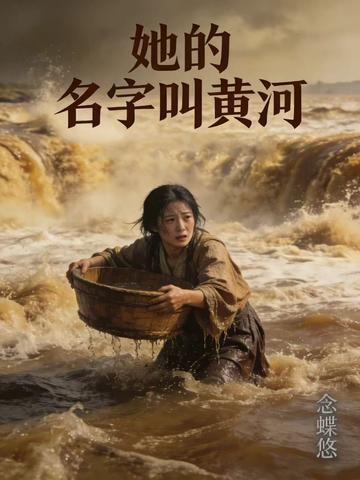
Core setting: 1938, Huayuankou. A seventeen-year-old fisherman girl on the edge of the Yellow River saw her village submerged by the blasted embankment. Her parents were gone, and her home was gone. She held a wooden basin and floated in the flood for three days and three nights before being rescued. Her rescuer asked her what her name was. She thought for a moment and said, "My name is Huang He." From then on, she followed the fleeing people all the way west. She has been a refugee, a worker, a factory, and a mother. She experienced the Anti-Japanese War, the Civil War, the founding of the People's Republic of China, and reforms. She watched the Yellow River overflow, control the Yellow River water, and stabilize the Yellow River. She lived to be a hundred years old. Before she died, her grandson asked her: "Grandma, what is your name?" She smiled and pointed to the Yellow River outside the window: "That's my name."
Unique value: Personal history is the history of the nation. Use the eyes of a little person to see the Yellow River and China over a century. Unit drama structure, each chapter is a slice of an era.
Reader comments
There are no fancy words, no deliberate sensationalism, and only the simplest line drawings to bring to life a hungry, poor, and somewhat resigned little girl in troubled times.
From the hungry stomach, to the stinging straw sticks, to the ewe that suddenly died while pregnant, every detail is heavy, solid, and weighty.
There is no need to shout or scold the suffering of the times, it is hidden in the mat, the muddy water, the thin quilt, and the silent parents.
The writing power is particularly stable, the atmosphere is particularly accurate, and the emotions are restrained and strong. As soon as he opens his mouth, he will bring people back to that era of war and chaos and precarious life.
It's the kind of writing that gets stronger the more you read it, and you can tell at a glance that it's written by a storyteller.
Clean, powerful, smoky, and full of human sorrow and joy.
With a meal of sweet potato buns and a few short conversations, the child's grievance and helplessness, the mother's toughness and distress, and the family's suffering and hope are truly and movingly described.
This is the stability after suffering and the concern at the end of the years. The words are as light as water and have great stamina.
The simplest words, the most touching emotions. Super super pretty
The simplest words, the most touching emotions, super, super beautiful
There are no fancy words, no deliberate sensationalism, and only the simplest line drawings to bring to life a hungry, poor, and somewhat resigned little girl in troubled times. From the hungry stomach, to the stinging straw sticks, to the ewe that suddenly died while pregnant, every detail is heavy, solid, and weighty. There is no need to shout or scold the suffering of the times, it is hidden in the mat, the muddy water, the thin quilt, and the silent parents. The writing power is particularly stable, the atmosphere is particularly accurate, and the emotions are restrained and strong. As soon as he opens his mouth, he will bring people back to that era of war and chaos and precarious life. It's the kind of writing that gets stronger the more you read it, and you can tell at a glance that it's written by a storyteller. Clean, powerful, smoky, and full of human sorrow and joy. With a meal of sweet potato buns and a few short conversations, the child's grievance and helplessness, the mother's toughness and distress, and the family's suffering and hope are truly and movingly described. This is the stability after suffering and the concern at the end of the years. The words are as light as water and have great stamina.
The simplest words, the most touching emotions. Super super pretty The simplest words, the most touching emotions, super, super beautiful