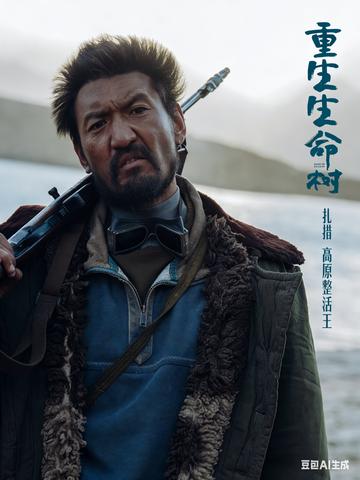
Reborn as the troubled Zacuo in "The Tree of Life", bound to the plateau's protective system, he is still a Kham man obsessed with organization and yearning for the grassland, but he is no longer a mountain ranger heading for tragedy.
To confront the mine boss, he opened his mouth and recited the poetry of the prairie; to protect Tibetan antelopes, he built an exclusive kindergarten to relieve the fatigue of mountain patrols; to fight poachers, he used his wit to set up a prayer flag trap and rewrite the ending of sacrifice.
He is not only the living treasure king of the mountain patrol team, amusing his bandmates and resolving difficulties and dangers; he is also a plateau poet in Sanjiangyuan, using wind as poetry and grass as rhyme, writing protection all over the plateau.
Guarding the snow-capped mountains, protecting living beings, taking care of fabrics, and ensuring safety, in this life, Zacuo will guard the entire source of the Three Rivers with integrity and poetry, so that tragedy will never happen again, and the grassland will always sing with joy!
Reader comments
The most touching thing about this article is that the tough and sincere Kham man Zhacuo in "The Tree of Life" was written into a plateau poet walking in the Sanjiangyuan. There is no bookish carving or deliberate piling up of words. His poems grow naturally from wind and snow, grassland, Tibetan antelopes and mountain patrols.
He had not read many books, his skin was tanned by the plateau sun, his body was as tall and straight as a pine and cypress, but his words had a poetic touch. He uses snowy mountains as rhyme, grassland as length, and protection as core. He combines his attachment to home, awe of life, and love of ordinary life into simple and hot sentences. He is bold and brave when facing poachers, but gentle and soft when facing creatures. Under his rough appearance, he hides the most delicate and soft innocent heart. This contrast makes the character particularly vivid and three-dimensional.
The author did not elevate or deify it, but just extended it along the soul of the original work: Zhacuo's poem is a confession to the land, a vow to protect it, and a romance hidden in the fireworks. He used the most straightforward words to describe the vastness and tenderness of the plateau, as well as the tenacity and beauty of life.
After reading it, I just felt that the mountains and rivers are speechless, but the poetry has a voice. Zhacuo has never been a scholar on paper. He himself is the poem written by Gaoyuan to the world, warm, clean and eternal.
The most touching thing about this article is that the tough and sincere Kham man Zhacuo in "The Tree of Life" was written into a plateau poet walking in the Sanjiangyuan. There is no bookish carving or deliberate piling up of words. His poems grow naturally from wind and snow, grassland, Tibetan antelopes and mountain patrols. He had not read many books, his skin was tanned by the plateau sun, his body was as tall and straight as a pine and cypress, but his words had a poetic touch. He uses snowy mountains as rhyme, grassland as length, and protection as core. He combines his attachment to home, awe of life, and love of ordinary life into simple and hot sentences. He is bold and brave when facing poachers, but gentle and soft when facing creatures. Under his rough appearance, he hides the most delicate and soft innocent heart. This contrast makes the character particularly vivid and three-dimensional. The author did not elevate or deify it, but just extended it along the soul of the original work: Zhacuo's poem is a confession to the land, a vow to protect it, and a romance hidden in the fireworks. He used the most straightforward words to describe the vastness and tenderness of the plateau, as well as the tenacity and beauty of life. After reading it, I just felt that the mountains and rivers are speechless, but the poetry has a voice. Zhacuo has never been a scholar on paper. He himself is the poem written by Gaoyuan to the world, warm, clean and eternal.